Distribution Is the Ticket, Not the Moat
Each attention channel opens, saturates, and closes. We are in the middle of one.
A few weeks ago, OpenAI acquired TBPN, a daily tech show run by two guys talking into microphones. The reported price was in the hundreds of millions. Most people read the news the same way: distribution is the new moat.
They got it half right.
The part about distribution being scarce and valuable is correct. The part about it being a moat is where the argument breaks. Founders who read that headline as a strategy will spend the next three years winning an arbitrage that has already started pricing them out.
Production went free. Attention didn’t.
Building things used to be the hard part. You raised money to manufacture something scarce, and scarcity did the work of making you defensible. Attention was the abundant input. People looked at what you made because there was not much else to look at.
AI broke that assumption.
Building is now close to free. A teenager with a decent laptop can ship a working product over a weekend. A team of three can generate more content in a day than a media company produced in a year. Whatever you shipped last month is one model release away from being reproduced by someone who started learning to code last Tuesday.
Human attention did not follow. The population is still under nine billion, and a day is still twenty four hours. Nothing about AI expanded the number of minutes a person is willing to spend looking at a screen.
So the ratio flips. The supply of things to look at grows without limit. The supply of eyeballs does not. CPMs can only go in one direction. The old founder playbook assumed capital was the scarce resource and attention was the cheap one, and both of those assumptions are now wrong.
This part of the distribution thesis is right. The question is what you are supposed to do with the insight.
Every distribution window closes.
The popular version of the argument goes like this. Building is commoditized. Attention is scarce. Therefore distribution is the one remaining moat. Build a creator pipeline. Run clipping. Learn the algorithm.
This is a correct diagnosis pointing at the wrong prescription.
Distribution is not the moat. It is the ticket that gets you into the room where moats get built.
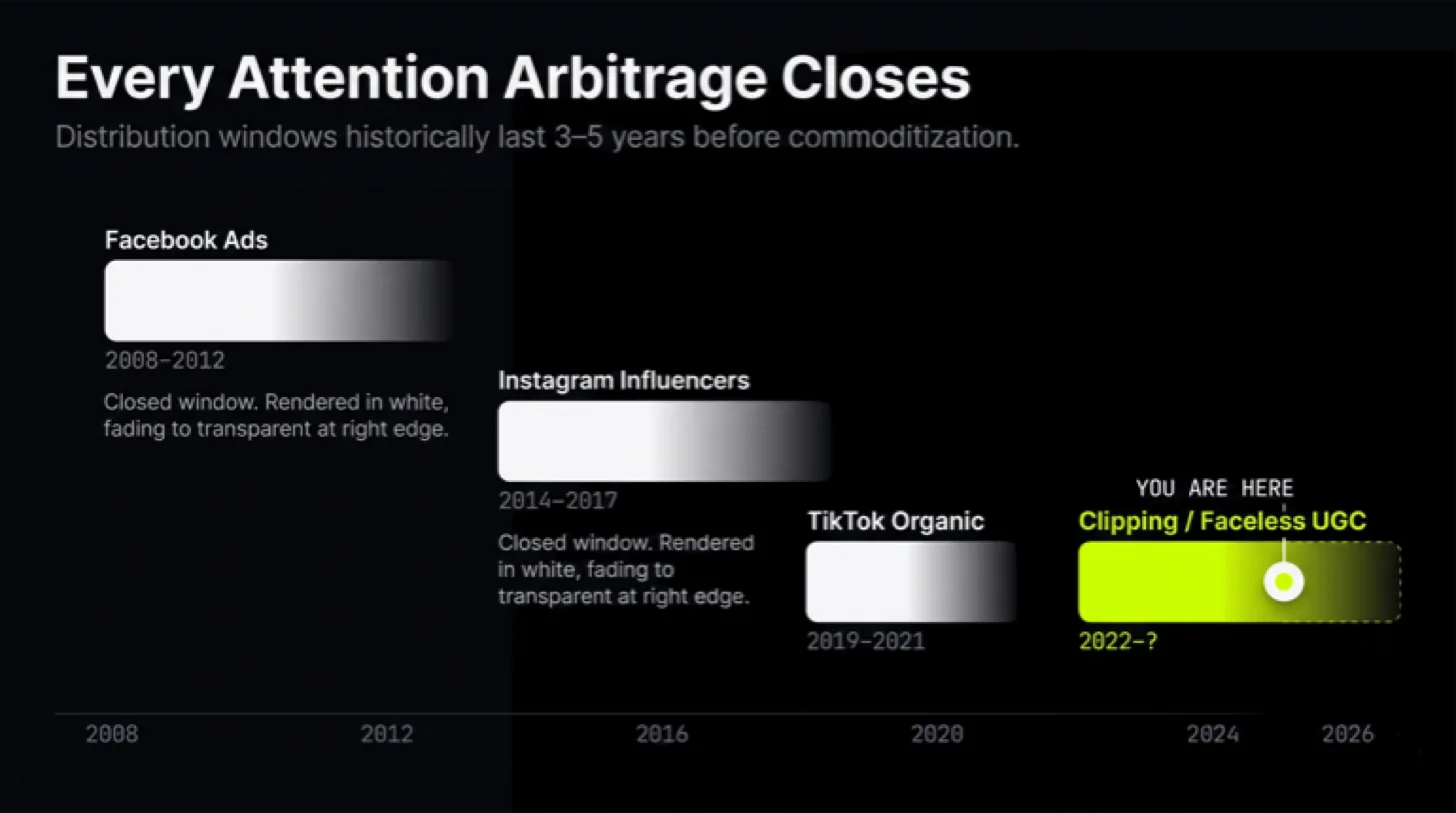
In the short term, the two feel identical. A consumer app with a creator flywheel doing eight figures in revenue looks defensible from the outside. Zoom out by a few years and the picture changes. Every major attention arbitrage of the last fifteen years has opened, saturated, and closed inside a three to five year window.
Facebook Ads from 2008 to 2012 were the clearest example. Early operators acquired users for the price of a coffee and scaled to category leadership. By the end of the window, costs had climbed by more than an order of magnitude and the edge had evaporated.
Instagram influencer marketing ran its cycle between 2014 and 2017. A creator with a million followers would accept low four figure deals. Once agencies organized the supply and brands realized what they were buying, those same creators priced themselves into the mid five figures and the arbitrage was gone.
TikTok organic from 2019 to 2021 gave small accounts reach that rivaled television. Then the algorithm was tuned toward retention, paid placement took over the For You page, and organic reach collapsed for everyone who had not already built off the platform.
Short form clipping and faceless UGC from 2022 through today is the current window. It is still working. It will not stay working forever.
Every founder who rode one of these waves and mistook it for a structural advantage got flushed out when the tide went back. The ones who are still around used the cheap window to build something the next cycle could not erase. A brand. A dataset. A product users could not replace without pain. A community that held together when the algorithm turned.
That is the piece missing from the clipping thesis. Distribution supercycles never end in victory. They end in price normalization, and everyone who confused the ride with a business ends the ride without one.
The smart money is buying audiences, not channels.
Look at the acquisitions being cited as evidence for the distribution thesis. OpenAI buys TBPN. Stripe buys Indie Hackers. HubSpot buys The Hustle. Paramount buys The Free Press. a16z spins up its own media operation.
The shallow read is that attention has become valuable.
The deeper read is that vertical integration is back.
When Amazon bought Whole Foods, the move was not about groceries. It was about owning the physical shelf in a world where physical shelves were about to become the scarce asset. The wave of AI companies acquiring media properties is the same logic, one generation later, applied to a different scarcity.
When the entire industry has access to the same foundation models, the same open source stacks, the same pools of creators willing to post for CPMs, the product layer collapses into undifferentiated commodity. The only way to stop that collapse is to own the channel between your product and the people who use it, not rent it back from the platforms every quarter.
OpenAI did not pay a nine figure number for a podcast. They paid for a standing channel into the minds of the people who decide which AI wins. An audience they do not have to reacquire every time a competitor ships a better model. A piece of distribution that cannot be bid away at the next auction.
That is the move a founder should be copying. Not the clipping campaign.
Distribution is the shortest-lived moat on the board.
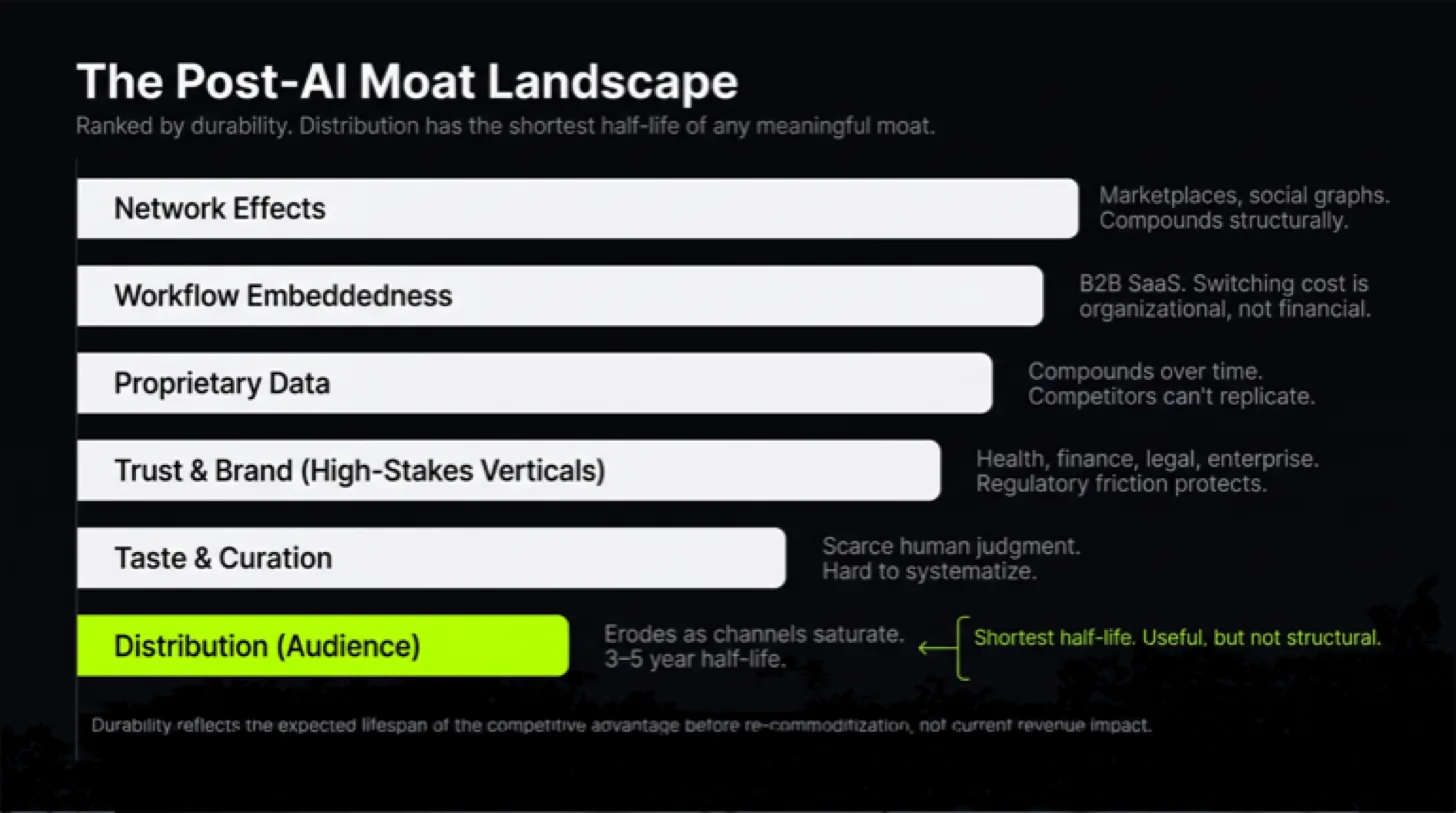
“Distribution is the only moat” is a strong tweet and a weak strategy. Put distribution next to the other candidates and its position becomes obvious.
Network effects remain the most durable structural advantage available to a startup. Every new user makes the product more valuable to every other user, and competitors cannot copy the graph. Very high durability.
Workflow embeddedness is the quiet B2B moat. Once your software is wired into how a team actually operates, the cost of ripping it out is measured in reorganized processes and retrained employees, not subscription fees. Very high durability.
Proprietary data is a compounding asset, but only when the product generates information competitors genuinely cannot get elsewhere. Public data scraped from the same sources is not a moat. Unique data from a unique workflow is. High durability in the narrow case.
Trust and brand in regulated verticals such as health, finance, legal, and enterprise hold up because AI commoditization runs into licensing, liability, and the plain human reluctance to hand a high stakes decision to an unknown vendor. High durability for anyone willing to do the unglamorous compliance work.
Taste and curation become the scarce human input in a world of infinite production. Anyone can generate. Almost nobody can reliably pick. Medium-high durability, but it depends on individual talent and does not systematize cleanly.
Distribution works, especially for consumer and media, but the channel is always changing hands. What used to be cheap gets expensive. What used to be organic gets paid. What used to reach millions gets throttled. Medium durability on the best day.
Put the list in order and distribution sits at the bottom. It is the moat with the shortest half life and the one most exposed to external forces you do not control.
Founders who understand this stop treating distribution as the destination. They treat it as the runway. It buys them time to build an actual moat before the window closes.
If the diagnosis is right, the playbook changes.
Use the current window, but know it is a window. Clipping and faceless UGC still work. Run them. But the signs of saturation are already visible. Platforms have started flagging and downranking synthetic content. Creator supply keeps growing. The brands willing to bid for that attention keep multiplying. You have maybe eighteen to thirty six months before the economics look more like Meta Ads than the free reach of two years ago.
Convert rented attention into owned infrastructure. Every piece of content that goes viral should end somewhere you control. An email list. A community. A product surface that generates its own data. A workflow a user cannot rip out without friction. If the only thing left at the end of this cycle is a list of people who once saw your app, you will be where the 2014 influencer-dependent brands were when Instagram changed its algorithm: visible, profitable, and one update away from irrelevant. This matters even more in B2B, where real distribution has always been embeddedness. Getting wired into the tools a team uses, integrated with procurement, trusted by the buyer. No amount of short form video changes an enterprise buying cycle. Do not import the consumer playbook into a motion that was never going to respond to it.
Build the bundle. The OpenAI and TBPN pattern will cascade downmarket over the next two years. Smaller companies should be thinking now about acquiring or locking in long term partnerships with the content properties most adjacent to their category. The math will never be cheaper than it is at the start of the trend.
Bet on taste. When production is free, judgment becomes the scarce input. The highest paid roles of the coming decade are not the people who can make content, because everyone can make content now. They are the people who can reliably pick which content, which product, which moment is worth amplifying out of an infinite pile of options. Hire for it. Protect the people who have it. Compound it over years.
The arbitrage is real. It’s just not the moat.
Everything the distribution thesis says about the attention economy is correct. The squeeze is happening. The founders writing long threads about it are not wrong. They are demonstrating the argument while they make it.
The mistake is in the word “moat.” A moat is something that lasts across cycles. Distribution survives the current cycle and gets reset in the next one. That is a useful asset, not a defensive one.
The more honest framing is less exciting but more useful. We are inside an arbitrage window. It will close on the same schedule every previous window closed on. The winners at the end of this cycle will not be the teams that posted the most clips. They will be the teams that used the cheap attention of the last two years to build something the next cycle cannot flush away.
Distribution is the ticket. What you do once you are in the room is the moat.
Do not confuse the two.