The thing you’re most confident about is probably wrong
On fluency, overconfidence, and why the experts most certain about the world are consistently the most wrong.
Confidence feels like accuracy. It isn’t.
When a belief comes easily, when you can state it without hesitation, defend it without looking anything up, that ease is a sign of rehearsal. Not a sign of truth. The brain mistakes familiarity for validity.
The more often you’ve encountered an idea, the more fluently it returns, and the more certain you feel. Psychologists call this the illusion of knowing. It’s not a bug in unusual cases. It’s how memory works.
This has consequences worth being specific about.
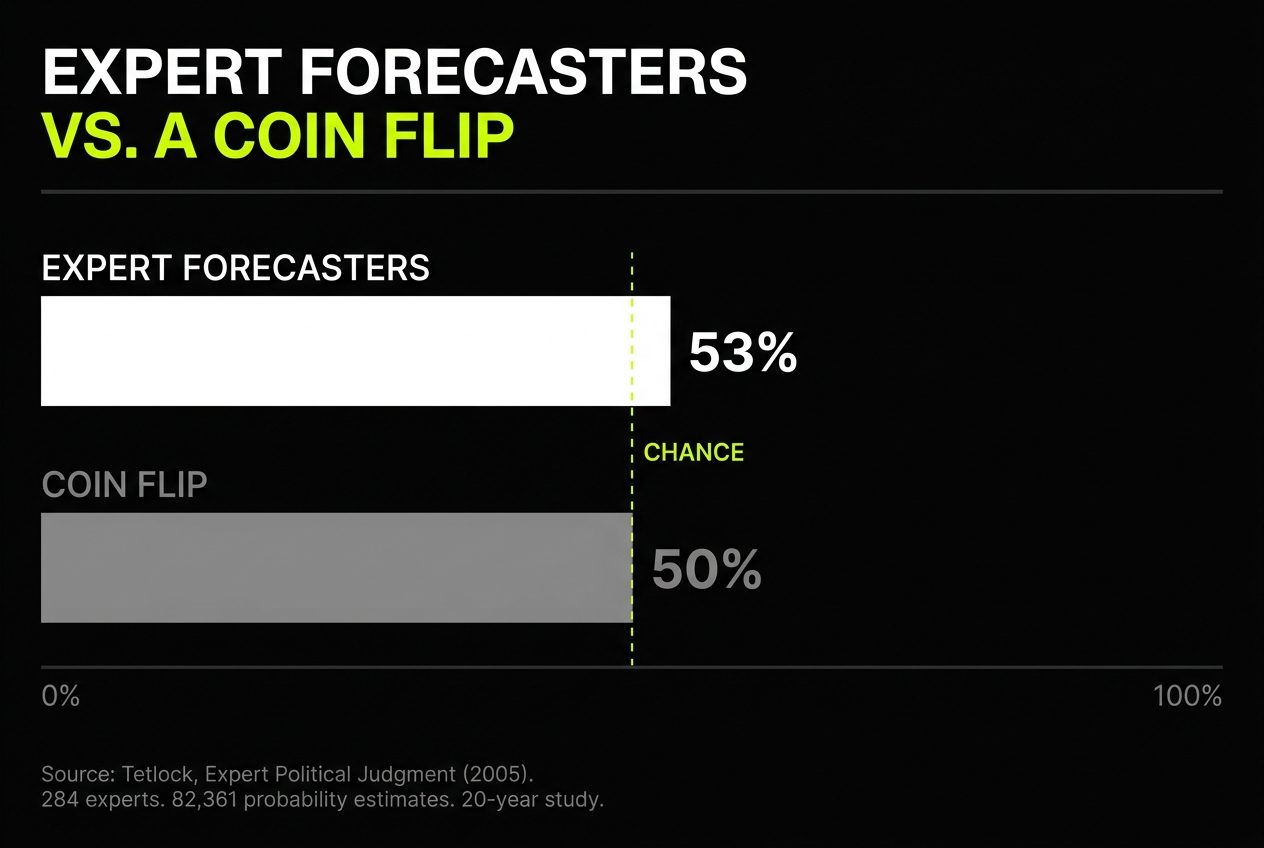
Philip Tetlock tracked expert predictions for 20 years (Link). Economists. Foreign policy analysts. Political strategists. People with credentials, frameworks, and years of accumulated judgement. They were sure of their views.
They barely outperformed coin flips.
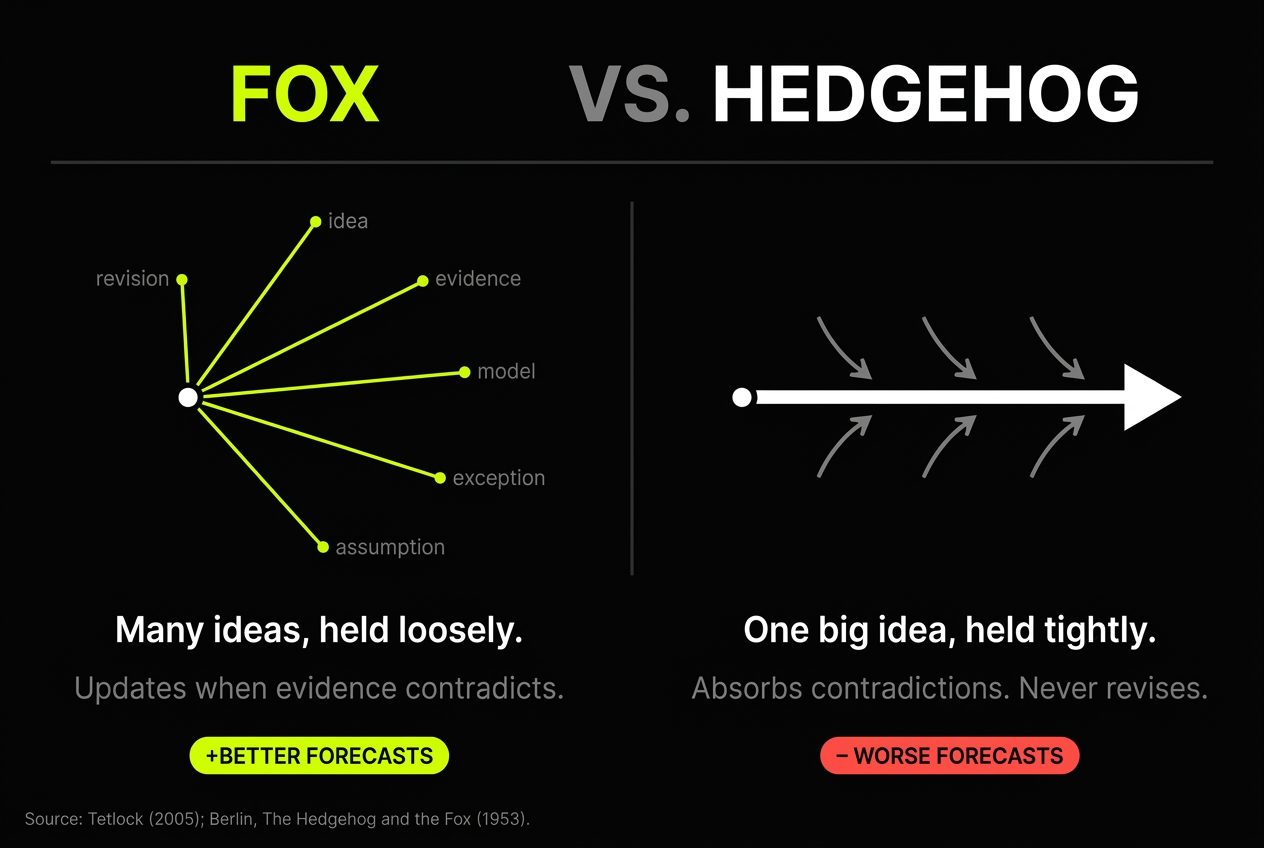
The better predictors weren’t the most credentialed or the most certain. They were the ones hardest to pin down — lots of small ideas, held loosely, revised often. Tetlock called them foxes, borrowing from Isaiah Berlin’s taxonomy. The people built around one confident framework — hedgehogs — were the worst forecasters in the study. Not slightly worse. Significantly worse. The experts most certain about their understanding were the least accurate about the world.
The reason is structural. The hedgehog’s one big idea is also their lens for evaluating new evidence. Contradictory data gets absorbed into the framework explained away, reinterpreted, treated as an exception.
The framework is never disconfirmed. It just accumulates more elaborations. Confidence grows. Accuracy doesn’t.
Kahneman formalised the underlying mechanism: WYSIATI : what you see is all there is. The mind doesn’t search for what’s missing. It takes available evidence, constructs the most coherent story it can, and declares itself confident.
Confidence is a product of coherence, not completeness. A story with three consistent data points feels as certain as one with thirty. You don’t feel the missing evidence. You feel the story.
This is clearest in peer review. Papers are evaluated by people trained in the same field, on the same literature, with the same assumptions. The process selects for consistency within a paradigm, not for truth. Prestigious journals have higher retraction rates than mid-tier ones, not lower. They publish bolder claims inside established frameworks. Those claims have further to fall. The confidence of the institution mirrors the confidence of the individual: coherent, fluent, missing the right questions.
None of this is a character flaw. Overconfidence is the adaptive default. Acting quickly on your best belief is usually better than prolonged hedging. Across most decisions in ordinary life, confidence calibrated to fluency works fine. The error rate is low enough to be invisible.
The problem appears in specific conditions. When the world has changed and you haven’t. When a belief has never actually been tested against real stakes, only rehearsed in safe contexts where being wrong had no cost. When small miscalibrations compound over time — the career direction held with certainty for a decade, the assessment of a relationship, the theory of how your field works. The confidence built over years of fluency suddenly meets a situation where fluency isn’t enough.
The sign, when you’re in it, is that you’re explaining a lot of things away. Contradictory evidence keeps arriving, and you keep having reasons it doesn’t count. The framework produces explanations faster than the evidence produces doubts. You feel clear. You might be the most wrong you’ve ever been.
A question worth sitting with: when did you last update a belief you’d held for more than three years? Not because someone argued you out of it, that’s easy, argument happens inside the framework. But because you found evidence that didn’t fit, and followed it rather than explaining it away.
If you can’t remember, that’s information.
Confidence isn’t something to distrust. It’s something to calibrate, to ask what it’s actually tracking. Fluency or evidence. The feeling of knowing, or the thing itself. Most of the time it’s fluency. Usually that’s fine.
Sometimes it costs you everything.