For Anyone Thinking About a PhD in AI, Read this First
Everything I’ve learnt had nothing to do with the research. What I wish I knew on day one.
I went into a PhD in AI worried about the wrong things.
The math. The depth of the literature. Whether I was technically ready. I spent the summer before I started reviewing papers and linear algebra, preparing for what I assumed would be the hardest part.
Three years in, none of that was what was hard.
Knowing what to look for in a supervisor before signing a three-year contract. Recognizing when an idea was dead before I had spent three months on it. Reading a rejection letter and knowing what to take from it and what to ignore. Getting through the stretches (and there will be stretches) where nothing works and you have nothing to show for any of it.
The research is not the hard part.
I have had some version of this conversation more times than I expected. Friends wondering whether to apply. People already two years in, asking if what they are feeling is normal. Messages on LinkedIn from people starting with some version of the same question: “I am thinking about doing a PhD in AI. What should I know?”
I kept giving the same answers. So I wrote them down. Part of what is here comes from my own experience: the mistakes, the things that worked, what I would do differently. Part of it comes from conversations with PhD friends who let me borrow their observations. And part of it is just what I believe actually shapes a PhD, which turns out to have very little to do with the research itself.
Some of this is specific to France, because the system here works differently than in the US or the UK. But the core of the experience is the same everywhere.
How It Works in France
If you are not familiar with the French system, this part might surprise you.
In France, a PhD is a job. You sign a three-year fixed-term contract called a CDD, which means you get a salary, social security, the whole thing. Technically you have a dual status: you are still a student at the university, but from the perspective of the lab and the government, you are an employee. The salary is modest, especially compared to what AI engineers make in industry.
You can also choose to teach. It is optional, not mandatory. About 64 hours per year. Teaching forces clarity. When you have to explain attention mechanisms to undergraduates who have never heard of them, you find out fast whether you actually understand what you are talking about. That carries over into your writing.
The goal over three years is to publish two or three strong research papers and defend your thesis. That is the output. The courses, the conferences, the workshops: those are just inputs. Worth keeping your eye on the output.
Do Your Homework Before You Commit
A PhD is a three-year commitment. In some countries, even longer. You would not take a three-year job without understanding the team, the role, and the environment. This is no different.
The best way to test the waters is through a Master’s internship in the lab. Six months is enough to see how people actually work. Not the polished version on the website, but the real day-to-day. Pay attention to whether people seem engaged or just going through the motions. If something feels off during those six months, trust that feeling. It is much easier to walk away from an internship than from a three-year contract.
The other thing worth doing is talking to former students. Current students in a lab will often be careful about what they say. They still depend on the supervisor. But alumni have nothing to lose. Find a few on LinkedIn, call them, and ask a few direct questions: “Knowing what you know now, would you do it again? How much work did you put in per week? What did the supervisor expect from you?”
The honesty of those answers will tell you more about the lab than any website or interview ever could.
Finally, make sure the project itself is well defined before you start. Vague projects are dangerous. If someone tells you “we will figure it out as we go,” that should worry you. Try to define what you will actually deliver in Year 1. Not a direction. A deliverable. And make sure the funding is confirmed for the full three years. Vague scope combined with uncertain funding is how PhDs fail.
Your Supervisor Matters More Than the Project
This is the most important thing in this post.
Your supervisor is the single most important variable in a PhD. More than the topic, more than the lab, more than the university. You can adapt to a boring topic. You can deal with limited compute or a messy lab environment. But a difficult supervisor is very hard to recover from once you are locked in.
Picture this: you have been working on a paper for four months. The experiments are finally running cleanly, the story is coming together, and you need feedback to sharpen the contribution before the submission deadline. You send your draft. Three weeks pass. No response. You follow up. A one-line reply: “will look at it soon.” The deadline arrives. You submit something that could have been significantly stronger with two hours of your supervisor’s time. That is not an edge case. For students who chose poorly, that is just how the PhD goes, for three years.
You are going to work with this person more closely than almost anyone else in your life for three years. You depend on them for guidance, for paper feedback, for career recommendations, for support when everything feels stuck. That is a lot of weight on one relationship.
A boring project with a good, honest supervisor is far better than an exciting project with someone who makes your life difficult. The project will evolve anyway. A bad relationship poisons everything.
Green flags:
- They give you credit when you do good work
- They respect your time and boundaries
- They ask what you think before telling you what to do
- They open doors: introductions, collaborations, conferences
Red flags:
- Messages late at night expecting immediate responses
- Taking first-author credit on work you did
- Micromanaging your experiments
- Making you feel stupid for asking questions
These patterns rarely improve over time. Changing supervisors or labs is painful, but it is better than spending three years in a bad situation.
One more thing worth thinking about: there are roughly two types of supervisors. Early or mid-career professors tend to be motivated, accessible, and genuinely invested in your work. Some will even sit with you and debug code. The trade-off is they have less experience navigating the field and fewer connections. Senior professors offer the inverse: deep experience, strong networks, and a name on your CV that opens doors. The trade-off is they often carry heavy obligations and large student loads, which means less of their time for you.
Neither is better. It depends on what you actually need. If you want close mentorship and daily engagement, look for someone early in their career. If you want to benefit from long experience and a strong network and can work more independently, a senior supervisor might be the right fit. Know yourself before you choose.
Your Lab Community Is Your Safety Net. Choose It as Carefully as Your Supervisor.
Your supervisor is the most important person in the lab. But they are not the only one who matters.
The people you share a lab with, the other PhD students, the post-docs, the engineers, matter more than most people expect. These are the people you will see every day for three years. The ones you grab coffee with after a bad review. The ones who listen to your half-formed ideas at 3pm and tell you honestly whether they make sense.
A senior PhD student who has already been through what you are experiencing can save you weeks of going in circles. A post-doc who has published at the venue you are targeting knows exactly what the reviewers care about. These conversations are not extras. They are part of how research actually happens.
Some of the best ideas come from the in-between moments. Lunch breaks, hallway chats, someone casually mentioning a paper you had never heard of that ends up reframing your entire approach.
If you are choosing a lab, pay attention to the people, not just the supervisor. A lab where people actually talk to each other and share openly is worth a lot.
Stop Chasing Benchmarks. Focus on Mechanisms That Age Well.
AI moves uncomfortably fast. You can spend six months building a model, running experiments, writing up results, and then the day before your submission deadline, some company or another lab drops something that makes your approach look outdated.
Most AI PhD students carry what you could call SOTA Anxiety: a constant, low-grade worry that your work is becoming irrelevant while you are still working on it. Every new paper on arXiv feels like a threat. Every announcement from a big lab feels personal.
Two things help with this.
First, stop chasing benchmarks. Leaderboards change constantly. The numbers you are optimizing for today will be forgotten in two years. But understanding why something works, when it fails, what the limits are, what the actual trade-offs look like: that kind of knowledge compounds over time and does not expire when the next model drops. Papers that explain mechanisms age far better than papers that just report higher scores.
Second, pick your battles. You cannot compete with Google or OpenAI on compute. They have more resources than your entire university. But there are plenty of problems they are not working on: specific domains, niche applications, underserved languages, questions that require months of careful thought rather than thousands of GPUs. The less glamorous corners of the field where a PhD student can still do something original and meaningful.
“The goal of a PhD is not to compete with industry. It is to think about things industry does not have the patience to think about.” A senior researcher told me this early on, and it stuck.
Clean Code Won’t Save a Dead Idea
“Perfect is the enemy of good.”, Voltaire
There is a trap worth naming, especially if you come from a software engineering background.
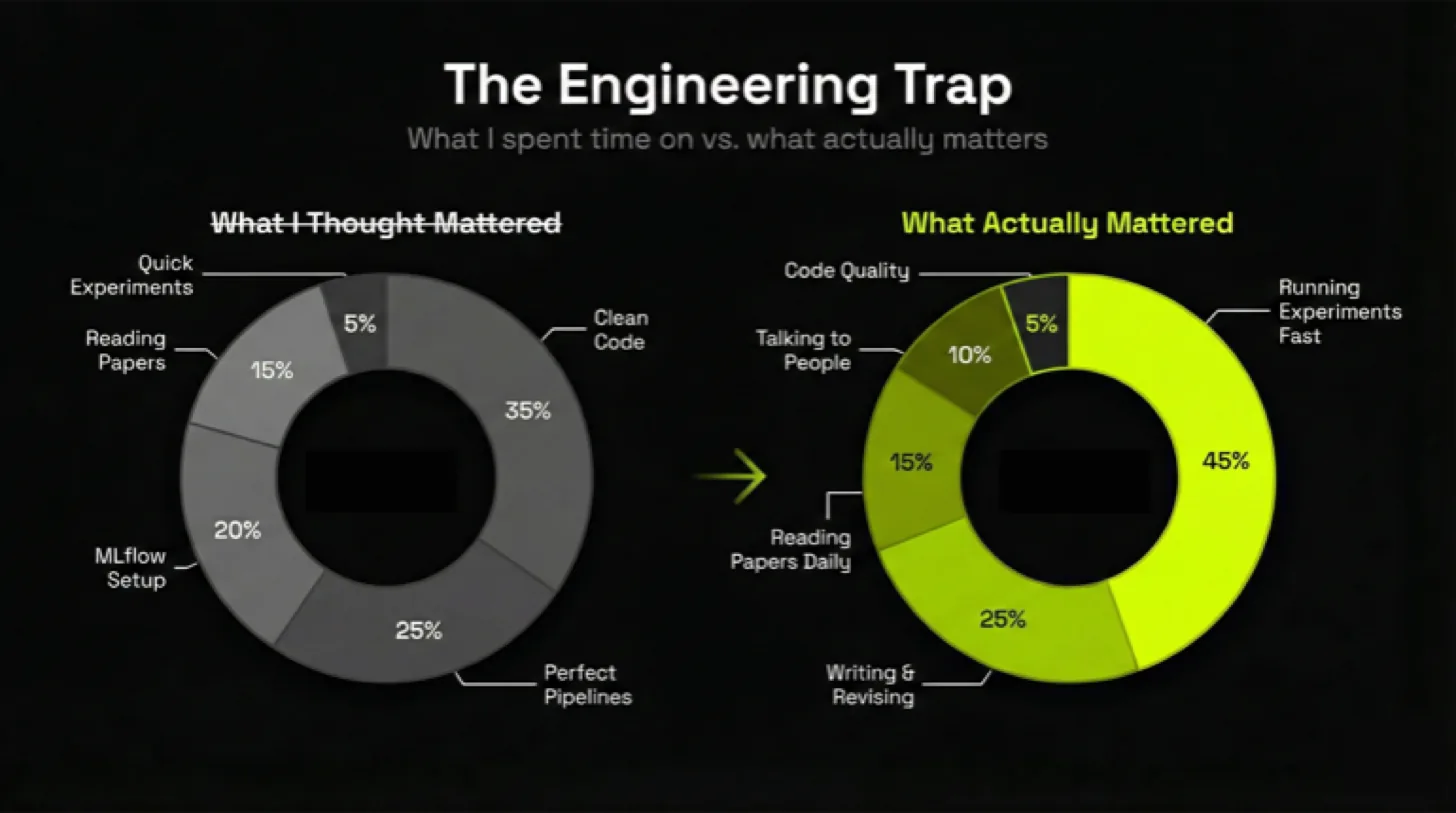
The temptation is to build things properly. Clean code. Scalable pipelines. Good architecture. Early in my PhD, I spent weeks building a perfect experimental setup before running a single meaningful experiment. I was proud of that codebase. It was elegant, modular, well-documented.
It produced zero contributions.
During a PhD, you are a scientist, not an engineer. The question is not “how clean is this code?” The question is “what is the fastest experiment I can run to test this idea?” The code can be ugly. If it gives you data that answers a question, it did its job.
Quick, messy notebooks beat production-grade systems every time.
Do Not Fall in Love With Your Ideas
“The first principle is that you must not fool yourself — and you are the easiest person to fool.”, Richard Feynman.
Your most scarce resource in a PhD is not compute, and it is not funding. It is time.
Three years sounds generous until you are inside it and realize how slow research actually moves. Experiments take weeks to run. Reviews take months. Revisions take more weeks. The clock never stops.
The difficulty is that staying with a weak idea feels like commitment. Walking away feels like quitting. But there is usually a difference, and it is worth learning to see it. Experiments with no signal after two weeks. Results that need too many caveats to be interesting. A story you cannot tell clearly no matter how many times you rewrite the introduction. Those are signals, not setbacks. The PhD students who finish on time tend to be the ones who learned to read them early and act without guilt.
When you have a new idea, give it a week or two. Run quick experiments. See if there is any signal. If after two weeks it is not showing promise, let it go and move on.
This feels brutal. It feels like giving up. But it is not. It is being realistic about how much time you have. The PhD students who finish on time are usually the ones who killed weak ideas early and invested hard in the ones that showed real potential.
Every month spent on a dead end is a month you cannot spend on the thing that would have worked.
Daily Reading Is How You Develop Research Taste, Not Just Knowledge
One to two hours a day, ideally in the morning. Not skimming abstracts on Twitter. Sitting down with a paper and actually working through it: understanding the method, looking at the experiments critically, thinking about what was done well and where the gaps are.
It is a hard habit to maintain. There is always something that feels more urgent: an experiment to run, code to debug, a deadline approaching. Reading feels passive compared to all of that.
But the periods of consistent reading tend to be the periods of best ideas. That is not a coincidence. Reading is how you develop taste, how you start seeing connections between papers that others miss, how you build an instinct for what is actually interesting versus what just looks impressive. The researchers who produce the most original work all seem to read a lot.
The common trap is reading in bursts: heavily before a submission, almost nothing after. That is not how knowledge compounds. Even an imperfect daily habit, a few papers a week instead of every day, pays off enormously over three years.
Great Results Die in Poor Papers. Writing Is Half the Game.
“Writing is thinking. If the writing is unclear, the thinking is unclear.” William Zinsser
You can have strong results and still get rejected because the paper is poorly written. Nobody teaches you this explicitly, but writing matters as much as the experiments.
Reviewers are busy. They are reading dozens of papers under time pressure. If your story is unclear, if the motivation does not land in the first page, if the structure is confusing, they are not going to fight through it to find your contribution. They will move on.
Different conferences expect different things. A paper for ICLR reads differently than one for CVPR or EMNLP. The community, the style, what counts as strong motivation, the level of formalism. It all varies. Learning to adjust your writing to the venue is not about being fake. It is about understanding your audience.
One of the best ways to improve: read accepted papers at your target venues, not just for the ideas but for the structure. You start to notice how they set up the problem, how they frame the contribution, how they handle limitations. Those patterns become templates in your head.
Writing also takes longer than most people expect. Budgeting a week to write up a paper is almost never enough. It works better to treat writing as something that happens throughout the project, not as a final step you reach at the end.
Separating Your Identity from Your Research Is the Hardest Skill to Learn
“People are disturbed not by events, but by their opinions about events.”, Epictetus
Here is a moment most PhD students will recognize. You have spent three months on a paper. You know every experiment, every number, every sentence. It has become your whole world. Then the reviews come back. One reviewer, one person reading your work alongside forty others under time pressure, writes two dismissive lines that suggest they missed the main contribution entirely. And somehow it does not feel like a paper got rejected. It feels like you got rejected. Your work, your thinking, your months. Dismissed in two sentences.
That is the trap nobody warns you about.
When you spend months working on a paper, it stops being just a paper. It becomes part of your identity. Your time, your thinking, your energy. All compressed into one document. So when things go wrong, it does not feel like a project failed. It feels like you failed.
The highs and lows in research are extreme, and they come fast. Breakthrough to dead end in a week. Excitement about a new result to realizing it does not replicate. These swings do not slow down as you progress. They just become more familiar.
The hardest part of a PhD might be learning to separate who you are from what you produce. That takes time, and it never fully goes away. But it gets easier.
What helps is having things in your life that have nothing to do with research. Training, friendships outside the lab, creative work, faith practice. Anything where your sense of self is not tied to whether an experiment worked. The PhD students who handle setbacks best are usually the ones whose identity does not live entirely inside the lab. When research is your whole identity, every setback breaks something. When it is one part of a fuller life, you can absorb the hits and keep going.
Burnout Is Real, and Working Harder Does Not Fix It
Here is what actual burnout looks like, not the version people describe in retrospect, but the version you are living in: you open a notebook you wrote three days ago and cannot follow your own reasoning. You run an experiment you have done a dozen times and make a basic error. You sit at your desk for seven hours and produce nothing you do not delete. You are not thinking anymore. You are performing the appearance of thinking.
The problem is not effort. You are giving everything.
The problem is there is nothing left to give.
The instinct, when this happens, is always the same: push harder. Put in more hours. If the experiments are not working, it must mean you are not working enough.
That is wrong. Research is not linear. Fourteen hours at your desk does not give you twice the output of seven. After a certain point, the brain shuts down. You stop seeing patterns. You make mistakes. You stare at code you wrote the day before and cannot follow it.
With that said, volume does matter. The goal is not to work less, it is to work better. Optimize first for quality and deep focus, then add volume on top of a sustainable base. I burned out multiple times during the PhD by working seven days a week under the assumption that more hours meant better results. It does not, and it is not sustainable. Build a weekly structure you can actually hold, and take at least one full day off. It helps you detach, reset, and start the next week with something left in the tank.
Three things tend to help:
- Setting limits. You teach people how to treat you. If you say yes to every paper review request, every collaboration someone floats your way, every seminar your lab expects you to attend, the PhD slowly becomes everyone else’s agenda. The month before a submission deadline is not the time to take on new obligations. Saying no to things that matter to other people, without guilt, is one of the harder skills to develop. But it is also one of the most necessary.
- Having something physical. For me it is running and swimming. What it gives you is something you do not realize you need until you have it: a clear win every single day. Even when experiments are failing, even when a paper gets rejected, you can finish a training session. That small daily proof of progress matters more than people expect. The point is to have a domain in your life where the feedback loop is short and honest, unlike research, where you can work for months without knowing if you are on the right track.
- Taking care of the basics. Brain fog is often tied to blood sugar and sleep. Cutting sugar and prioritizing sleep sounds boring, but the effect is noticeable fast. Stable energy, better focus, fewer afternoon crashes. It makes more difference than any productivity technique.
Rejection Is Not Evidence of Quality. The System Is Noisier Than You Think.
Rejection is not something that might happen. It will happen.
Acceptance rates at top AI conferences are around 25 to 30 percent. Most work, by most researchers, gets turned down most of the time.
The review process is noisy. Really noisy. The same paper can get a strong accept at one venue and a clear reject at another. It is not a clean, objective evaluation. It is a few overworked researchers reading your paper alongside dozens of others, under time pressure, forming opinions shaped by their own biases and blind spots.
And sometimes you get Reviewer 2. Every PhD student knows Reviewer 2. The one who clearly skimmed your paper in five minutes and left a dismissive two-line review. Or the one who gets personal, writing something harsh that has nothing to do with the science. It stings.
The system is imperfect. It is the best we have, but it is far from fair. Accepting that early saves a lot of suffering.
The quality of your work and the decision of a conference are not the same thing. A rejection does not mean your work is bad. An acceptance does not mean it is great. The decision is one data point, filtered through an imperfect process.
Take what is useful from the reviews. Improve the paper. Resubmit. The history of AI is full of important papers that were rejected on their first submission.
Why Managing Three Projects at Once Is Less Stressful Than Managing One
In AI, there are major conference deadlines every few months: ICLR, CVPR, ICML, ECCV, NeurIPS. It does not stop.
If you work on one paper at a time, finish it, submit it, wait for reviews, then start the next, you will not get three papers done in three years. The math does not work. Review cycles alone eat months.
The approach that works is keeping three things moving at different stages simultaneously:
- One paper submitted and going through review
- One being actively written up from completed experiments
- One still in the experiment phase, early and exploratory
It sounds like a lot. It is actually less stressful than working serially. When a paper gets rejected, it hurts less when there are two other projects moving forward. You are never starting from nothing. The rejection becomes a redirect, not a reset.
The Stack That Kept Me Sane
Tools matter less than habits, but the right tools do reduce friction. Here is what I actually use and why:
- Zotero + Scholar-Inbox. I used to lose track of papers I had already read, annotated, or cited. Zotero fixed that. Papers are tagged, annotated, and searchable. Scholar-Inbox helps surface related work I would have otherwise missed.
- Weights & Biases. I lost two weeks of experiment results early in Year 1 because I was tracking things manually in notebooks. After that, everything goes into W&B. If an experiment is not logged, it effectively did not happen.
- Overleaf + Grammarly. Overleaf for collaborative LaTeX writing. Grammarly catches the small things that slip through when you have been staring at the same draft for too long.
- Notion. Not as a task manager. More as a second brain for connecting ideas across projects. Half-formed thoughts that might matter later, observations from papers, things that did not fit anywhere yet.
- Calendar blocking. Deep work time gets scheduled like a meeting. If it is not on the calendar, the day fills with everything else and the real work never happens.
- Gemini Deep Research. Useful for literature review and related work sections. Saves hours. But verify every citation before it goes into a paper. Hallucinations are real, and a wrong citation in a submission is embarrassing in ways that are hard to undo.
The Best Research Conversations Happen Between the Talks
Conferences are not just about presenting your poster or sitting through keynotes. They are about the moments between.
Having dinner with a group of researchers you met that afternoon. A lunch where someone casually mentions a dataset or a framing you had never heard of, and it ends up reorienting how you think about your own work. Conversations in hallways between sessions that go deeper than anything that happened on stage.
There is something about being physically in the same room as people who are working on similar problems. You realize the field is full of real humans, not just names on papers. You meet PhD students from other countries navigating the exact same pressures. Senior researchers turn out to be surprisingly approachable at the right moment.
There is also just the travel. Conferences take you to places you would not otherwise go. That change of environment alone does something good for your thinking.
If your lab offers to send you to a conference, go. Even if you do not have a paper there. Some of the most useful things that happen during a PhD come from those conversations, not from reading papers, not from running experiments, but from being in the same room as the people who are shaping the field.
PhD Growth Is Exponential, Not Linear. The First Year Is the Trough.
Almost everyone goes through a difficult first year. Almost nobody talks about it openly.
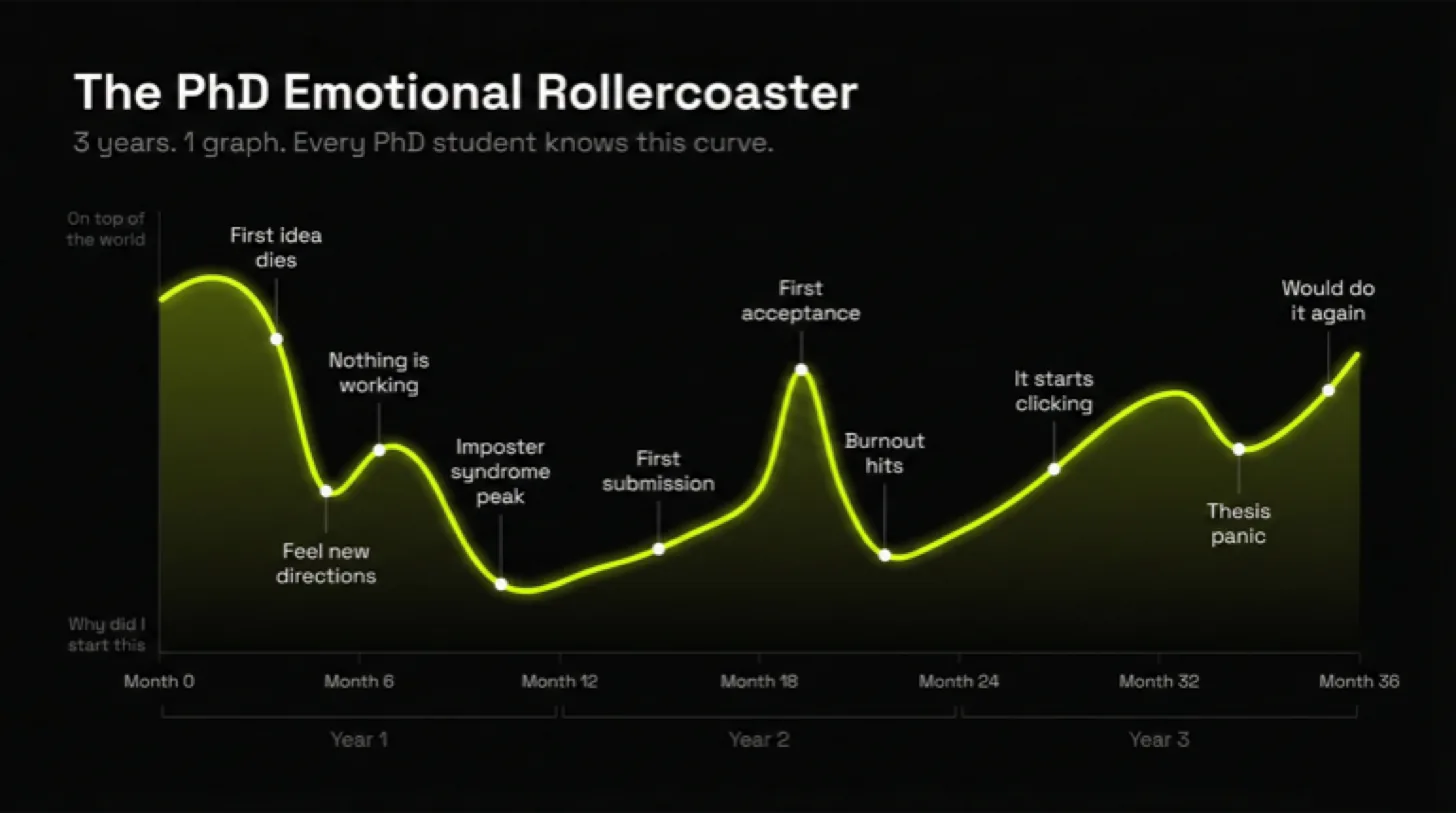
There is a period, usually in the first year, where you feel stuck. Your first ideas do not work. Or they work but not well enough to publish. You watch other people making progress and start wondering if you made a mistake. A year in, nothing to show for it, not sure this is going anywhere.
Unless you were very lucky and your first direction happened to work, this is normal. Most PhD students go through some version of it.
Here is the thing worth knowing: growth in a PhD is not linear. It is closer to exponential. During the first year, everything is slow. You are learning how to read papers properly, how the field actually works, what matters and what does not. You are building intuition that you do not even realize you are building. It does not feel productive because the visible output is small. But the foundation is compounding underneath.
In the later years, things start to click. You read a paper and immediately see the gaps. You have an idea and you can tell within a day whether it is worth pursuing. You write faster because you have absorbed enough to know what good writing looks like. The contributions come quicker, not because you are working harder, but because everything you accumulated in those slow early months is finally paying off.
If you are in your first year and it feels like you are going nowhere, you are probably not behind. You are just early.
What I Would Tell Myself on Day One
A few things, if I could go back:
- It is a marathon. There will be months with zero results and nothing to show. That is not a sign of failure. It is just what research looks like. Keep showing up.
- Stop comparing your timeline to other people’s. Some publish in Year 1, some in Year 3. The person who published early might have had a ready idea handed to them, a better dataset, more compute, or just got lucky with a reviewer. You do not know their full story. Focus on yours.
- Ask for help earlier than you think you should. It is easy to waste months spinning on a problem that a single conversation with a senior researcher could unblock in an afternoon. Asking for help is not a sign of weakness. It is the smarter way to work.
- The PhD is about more than the papers. It changes you in ways that are hard to measure. The discipline to sit with a problem for months without a clear answer. The resilience to get knocked down and come back. The ability to keep going when nobody has the answer yet. Those things stay with you long after the specific papers are forgotten.
The PhD Does Not Lock You In. It Creates Paths That Did Not Exist Before.
At some point, usually around Year 2 or 3, the question starts sitting in the back of your mind: what comes after?
The traditional paths are well known:
- Academia. Freedom to choose your direction and mentor students, but the competition for positions is intense, the pay is modest, and the publish-or-perish pressure never fully stops.
- Industry research. Places like Google DeepMind, Meta FAIR, or Microsoft Research pay better and give you more resources, but you have less control over what you work on and the timelines look different.
- Startups. You move fast and build things, but the work is less about pushing the boundaries of what is known and more about making things work in practice.
The PhD does not lock you into one track. If anything, it gives you the ability to choose, and to create paths that did not exist before you started.
What It Does to You
“The impediment to action advances action. What stands in the way becomes the way.”, Marcus Aurelius
There are mornings when you question why you are doing this. Experiments failing for weeks. A reviewer tearing apart something you spent months on. A Sunday evening realizing you have not fully switched off in three weeks and still have nothing to show for it.
But if you are genuinely curious about the problems, if the questions keep pulling you in even when everything is broken, it can also be one of the most interesting things you do. You get a kind of freedom that most jobs do not offer. You get to follow your thinking wherever it leads. You are not executing someone else’s plan.
And here is what is easy to miss until you are inside it: the stress and the uncertainty, the exact things that make the PhD hard, are also the things that change you the most. Three years of dealing with rejection, ambiguity, and slow progress does something permanent to you. You come out more comfortable with not knowing. More patient with things that take time. More willing to invest effort long before you see any return.
It does not just make you a researcher. It builds a kind of steadiness that carries into everything after: how you handle setbacks in work, in relationships, in any pursuit that demands more patience than the world usually rewards.
I am still in the middle of it. Still figuring things out, still making mistakes. But if you are thinking about starting, or if you are already in it and feeling the weight of it, I hope something here helped.
If this resonated, I write about research, building, and what it actually looks like to do both at once. You can follow along here.
—Imad