The Friction Model: Why Starting Is the Hardest Part
Why starting is harder than continuing, and how to engineer the fix
You’ve shipped things before.
Projects. Products. Results. You know what execution feels like once you’re moving. That’s not the problem.
The problem is the space between deciding and doing. The gap where things die.
I have a folder on my desktop called “Started.” It’s full of half-finished projects, abandoned drafts, ideas that seemed urgent at 2am and impossible at 9am.
I’m not uniquely bad at this. Everyone I know who builds things has a version of this folder. The question that kept nagging me: why?
It’s not capability. We’ve all proven capability. It’s not desire. We want to do these things. So what is it?
The standard answer is motivation. “You just need to find your why.” “Discipline equals freedom.” “Push through.”
I tried pushing through for years. Sometimes it worked. Mostly it didn’t. And when it didn’t work, I assumed the problem was me. Not motivated enough. Not disciplined enough. Not serious enough.
This is wrong. And it took me embarrassingly long to see why.
The problem isn’t motivation. It’s friction.
The Motivation Trap
Here’s a sentence that sounds reasonable and is completely backwards:
“I’ll do it when I feel motivated.”
You won’t. Or rather you might, but you’ll be waiting a long time.
Motivation doesn’t precede action. It follows it. You don’t feel like running until you’re already running. You don’t feel creative until you’re already creating. The feeling comes from doing, not before it.
This isn’t some mindset hack. It’s neuroscience.
When you complete an action—even a tiny one—your brain releases dopamine. That dopamine creates the urge to continue. The motivation to do the thing comes from doing the thing. Waiting for motivation first is waiting for an effect before its cause.
And yet.
Knowing this doesn’t fix it. I’ve known this for years. I’ve read the papers. I’ve listened to the podcasts. I still have days where the document doesn’t get opened. Where the workout becomes “tomorrow.”
Understanding the mechanism doesn’t automatically override it.
So what does?
Thinking About Friction
Here’s the reframe that actually helped me.
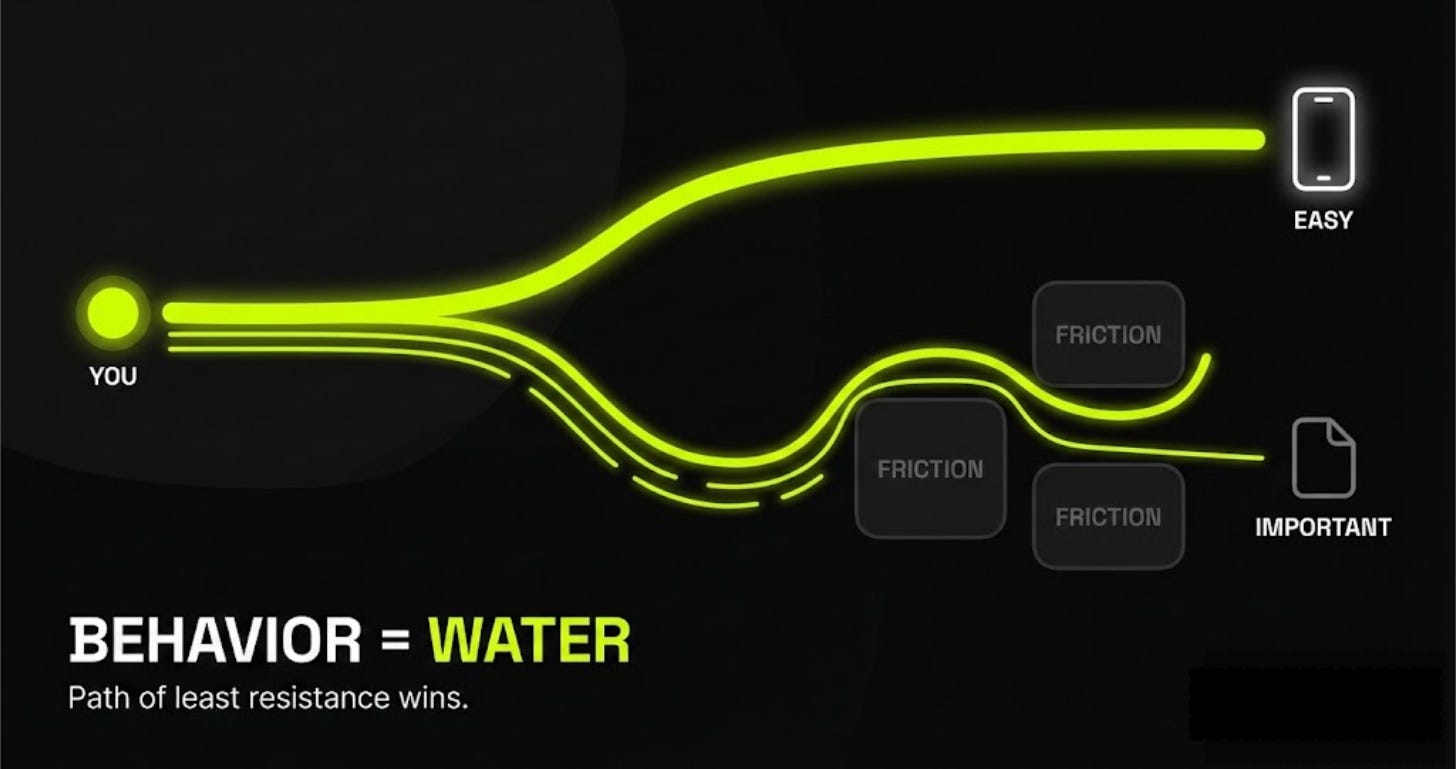
Think of behavior like water. Water doesn’t negotiate with gravity. It doesn’t “decide” to flow downhill. It takes the path of least resistance, every single time, without exception.
Your behavior works the same way.
Every action has friction—invisible resistance pushing against initiation. Some actions have high friction (starting a complex project). Some have almost none (checking your phone). The lowest-friction action wins. Not the most important action. Not the one you “should” do. The easiest one.
This is why you scroll Twitter instead of writing. The friction to open Twitter is near zero. The friction to open a blank document and think hard is much higher.
It’s not weakness. It’s physics.
The insight: stop trying to increase motivation. Start reducing friction.
This changes the question. Instead of “why don’t I feel motivated?”, which leads to self-flagellation and doesn’t help, you ask “where is the friction?” That question is actually answerable.
Three Flavors of Friction
Not all friction is the same. I’ve found it breaks into three types. Each feels different. Each needs different solutions.
Cognitive Friction
This is your brain’s confusion response.
“I don’t know where to start.”
“There are too many options.”
“I need to think about this more.”
Cognitive friction comes from ambiguity. Unclear first steps. Too many possible approaches. No obvious entry point.
Here’s the tell: you find yourself preparing to work instead of working. Organizing your desk. Reading “one more article” for research. Making lists about making lists.
I do this constantly with writing. I’ll spend an hour “getting ready to write”, adjusting fonts, re-reading notes, making coffee—and realize I haven’t typed a sentence. The preparation feels productive. It’s avoidance in disguise.
Emotional Friction
This is your brain’s fear response.
“What if it’s not good enough?”
“What if I fail?”
“What if people judge me?”
Emotional friction comes from anticipated negative outcomes. Your amygdala, the brain’s threat detector, doesn’t distinguish well between physical danger and ego threat.
A hard conversation activates similar circuits as a predator. Your body tenses before you’ve even started.
Here’s the tell: you feel it in your chest when you think about the task. A tightness. A low-grade dread. The task isn’t actually dangerous, but your nervous system doesn’t know that.
I get this with publishing. Every time I’m about to hit “post,” there’s this moment where my brain offers seventeen reasons to wait. To revise one more time. To send it to one more person for feedback. The fear isn’t of the writing, it’s of being seen.
Physical Friction
This is your brain’s energy response.
“I’m too tired right now.”
“I’ll do it when I have more energy.”
“I just need some coffee first.”
Physical friction comes from biological state. Sleep-deprived brains have reduced prefrontal function, literally less cognitive hardware available. Trying to do high-friction work in a low-energy state is swimming upstream.
Here’s the tell: the task feels reasonable when you imagine doing it tomorrow, but impossible right now.
This one took me longest to take seriously. I kept treating low energy as a character flaw rather than information. Now I schedule demanding work for mornings and coast in afternoons. Fighting biology is a losing game.
Most people experience all three types. But one usually dominates.
Knowing your primary friction type changes which interventions work.
- If your main blocker is cognitive (confusion), motivational speeches won’t help, you need clarity.
- If it’s emotional (fear), better planning won’t help, you need exposure.
- If it’s physical (energy), neither will help, you need sleep.
I built a diagnostic for this: The Friction Audit Worksheet. You pick a specific task you’ve been avoiding, score each friction type, and surface the root cause. Takes 15 minutes. Surprisingly clarifying. Get it here →
If you want to understand your general pattern, not just one task, but how you typically get stuck, there’s the Resistance Triad Self-Assessment. Same idea, broader scope. 10 minutes. Get it here →
The Dopamine Complication
There’s another piece to this that took me a while to understand.
Dopamine: the neurochemical behind motivation, doesn’t work how most people think. It’s not the “pleasure chemical.” It’s the anticipation chemical. It doesn’t fire when you get a reward. It fires when you expect one.
This matters because different activities create different anticipation signals.
Fast dopamine sources as social media, video games, news feeds, junk food, create massive anticipation spikes from minimal effort. Your brain learns: low effort, big reward.
Slow dopamine sources (i.e building things, getting fit, learning skills), create weaker anticipation signals. The reward is distant. Uncertain. Maybe never coming.
Here’s the problem: when you’ve trained your brain on fast dopamine, slow dopamine activities feel almost painful. The anticipation signal is so weak your motivation circuits barely fire.
This explains something I couldn’t figure out for years. I’d sit down to write something I genuinely want to do and feel nothing. No pull toward it. Meanwhile, the pull toward checking Twitter was overwhelming. It wasn’t that I didn’t want to write. It’s that my reward system had been hijacked.
“Just put your phone away” doesn’t fix this. The phone is a symptom. The problem is a miscalibrated baseline.
The real fix takes time: limiting fast dopamine sources, creating space between craving and action, letting your baseline reset. This is uncomfortable and slow. But it works.
The quicker fix: reduce friction on the work until it’s lower than friction on distraction. If checking your phone requires getting up, walking to another room, and unlocking a drawer, and your document is already open on screen, the math changes. You’re not fighting your reward system. You’re changing the friction equation.
Seven Principles
Here’s the operating framework I use. Seven principles that reduce initiation friction.
1. Reduce Friction, Don’t Increase Motivation
Stop trying to generate willpower. Start removing obstacles.
Want to exercise? prepare your workout clothes the night before. Put shoes by the door. Remove every step between waking and starting.
Want to write? Leave the document open before you close your laptop. Let it be waiting for you.
Every second of friction is a chance for resistance to win. Eliminate the seconds.
2. Start Before You’re Ready
Perfectionism is procrastination wearing a nice outfit.
Open the document. Put on the shoes. Write the first sentence.
You’re not trying to produce good work. You’re trying to enter the state where work becomes possible. Those are different things.
3. Engineer Your Environment
Your environment isn’t neutral. It’s either helping you or fighting you.
Studies suggest around 40% of daily actions are habitual, triggered by environmental cues, not conscious choice. What you see first, what’s in reach, what takes effort to access, these shape behavior more than intentions do.
I used to keep my phone on my desk while working. Constant battle. Now it is offline, far from my sight. Battle over. The environment changed. I didn’t have to be more disciplined.
Audit your spaces. What behaviors do they trigger?
4. Use Implementation Intentions
Vague plans die. Specific plans survive.
There’s a technique from psychologist Peter Gollwitzer called “implementation intentions.” Instead of “I’ll exercise more,” you specify: “At 7am, after I brush my teeth, I will put on running shoes and walk out the door.”
The format: “When [situation], I will [behavior].”
This increases follow-through by 2-3x. It pre-decides. It removes the cognitive friction of choosing in the moment.
I use this for writing: “When I sit down with coffee in the morning, I will write for 30 minutes before checking email.” The decision is already made. I just execute.
5. Leverage Identity, Not Willpower
Willpower depletes. Identity persists.
Every action is a vote for the type of person you’re becoming. Cast enough votes, you change the outcome.
Instead of “I’m trying to wake up earlier,” try “I’m someone who wakes up early.”
Sounds like semantics. It’s not. When your behavior conflicts with your identity, the identity usually wins. Make the identity work for you.
6. Protect Your Dopamine Baseline
Your motivation capacity depends on your reward system health.
This means: limit social media to specific windows. Avoid screens for the first hour after waking. Create effort before reward. Let your brain recalibrate.
I’m not great at this. I still check Twitter more than I should. But the days I protect the morning, no phone until I finish some workd, those are different days. The pull toward work is actually there.
7. Build Momentum Systems
Newton’s first law applies to behavior: objects in motion stay in motion.
Start small. Embarrassingly small. One pushup. One sentence. One minute.
The goal isn’t output. The goal is momentum. Once you’re moving, friction drops dramatically.
I used to think this was silly. One pushup doesn’t build muscle. But one pushup often becomes ten, because the hardest part was getting on the floor. And a day with ten pushups is infinitely better than a day with zero.
The Morning Protocol
Theory is useful. Protocol is better.
The first 30 minutes after waking are when your brain is most malleable. Cortisol peaks. Neuroplasticity is elevated. What you do in this window shapes your focus and energy for hours.
Most people surrender this window to their phone. They wake up, check notifications, and spend their highest-leverage mental minutes on other people’s priorities.
I did this for years. I’d check email before getting out of bed and wonder why I felt reactive all day. The inputs were setting my agenda before I’d even stood up.
Here’s what I do now:
Night Before (5 minutes)
Your morning starts the night before.
Write tomorrow’s single most important task. Just one. Pre-decide the first physical action—not “work on project,” but “open document and write first sentence.” Set up your environment. Set a sleep time.
This eliminates morning decision fatigue. You wake with direction already loaded.
Minutes 0-10: Physical Activation
Get vertical immediately. No snooze.
Expose yourself to bright light, open blinds, step outside briefly, or use a light therapy lamp. Light is the primary signal to your circadian system that the day has started.
Cold water on face. Light movement. Full glass of water.
The goal: sympathetic nervous system activation. Tell your brain we’re awake now.
Minutes 10-20: Zero Input
No phone. No email. No news. No social media.
Your brain is impressionable in this window. Don’t fill it with other people’s agendas.
What you can do: light stretching, get my coffee breakfast, sit quietly, start writing. Internal processing, not external consumption.
This was the hardest part for me. The pull to “just check” is strong. But the difference in my morning focus is noticeable enough that I keep doing it.
Minutes 20-30: Intention and Action
Review your most important task.
Brief visualization: see yourself completing it. Not starting—completing.
Then take the first action. Not preparation. Not organizing. The action itself.
By minute 30, you’ve won. You’ve created momentum before the world derailed you.
The full protocol, with daily checklist and 7-day tracking, is in The Morning Protocol Checklist. Printable, structured, with troubleshooting for common problems. Get it here →.
Edge Cases
“But my mornings are chaotic.”
Then start smaller. The non-negotiables: get vertical, get light, no phone for 10 minutes. Everything else can flex.
“But I work late nights.”
The protocol adapts to whenever you wake up. It’s about the first 30 minutes, not 6am specifically.
“But I’ve tried morning routines before.”
Most morning routines fail because they’re too ambitious or disconnected from actual work. This one is minimal and leads directly into your most important task. It’s not about optimizing morning for its own sake.
“But what about kids/roommates/chaos?”
Wake 20 minutes before them. Use the bathroom as your zero-input zone. Something is better than nothing.
The Upwind Conclusion
Here’s the thing underneath all of this: You are not your defaults.
Your brain came pre-configured for a world that no longer exists. Circuits optimized for scarcity, for threat detection, for conserving energy, these don’t optimize for creative work. For long-term projects. For the things that actually matter to you.
But the circuits aren’t fixed. They’re parameters. And parameters can be tuned.
The friction model gives you a way to think about that tuning. Instead of beating yourself up for not “wanting it enough,” you debug the system. Where is the resistance? What’s creating it? How do I engineer around it?
This is the shift from motivation to systems.
Motivation asks: “How do I feel about this?”
Systems ask: “What are the conditions that make this likely to happen?”
The second question is answerable. Actionable. Fixable.
I don’t know if this framework is exactly right. It’s the best model I’ve found so far. But even if the specifics are wrong, the orientation is useful: treat behavior as engineering, not character. Look for friction, not flaws.
You’ve already built things. You know how to execute once you’re moving.
Now you know how to get moving.
Implementation Resources
This essay gives you the model. These tools help you apply it.
- Friction Audit Worksheet: Diagnose friction on a specific avoided task. 15-20 minutes.
- Resistance Triad Assessment: Identify your dominant resistance pattern. 10-15 minutes.
- Morning Protocol Checklist: Daily checklist with 7-day tracking. 5 minutes per day.
What’s Next
Starting is only half the problem. The other half is sustaining.
In the next blog, we’ll cover attention architecture, why focus is broken in the modern world, and how to build systems that protect deep work.
Because it doesn’t matter how well you start if you can’t stay with the work long enough to finish.