The Search Space Problem
On failure, success stories and where to point your attention
Why is the internet full of failure stories?
“10 mistakes that ruined my health.” “What I learned from my failed marriage.” “Why I dropped out.” Post-mortems everywhere.
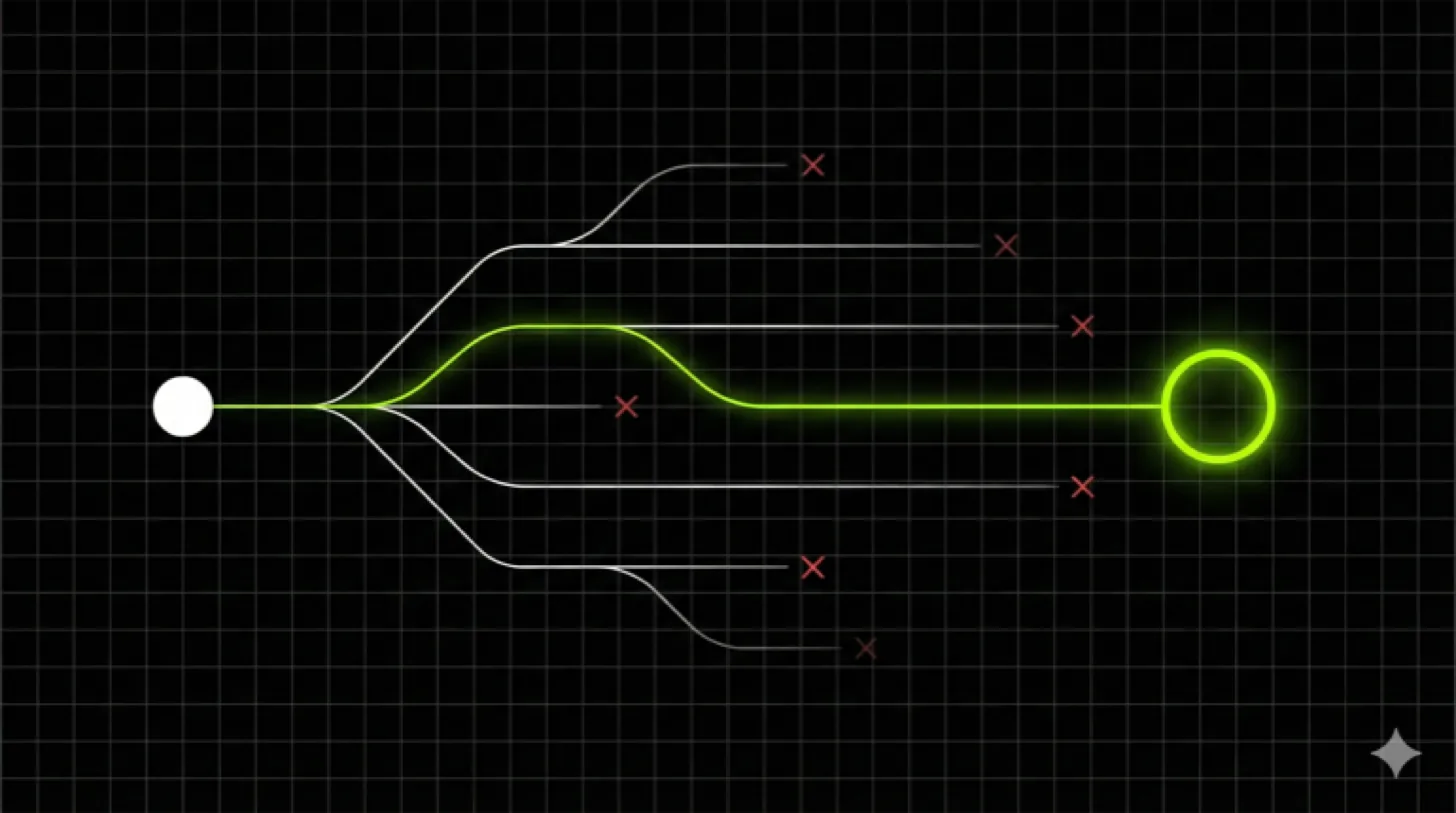
Success stories are rarer. Quieter. Harder to find.
I started thinking about why and whether we’re learning from the wrong source.
The Bug in How We Learn
We consume failure content obsessively.
Every “What went wrong” post. Every podcast dissecting mistakes. Every thread listing traps to avoid.
We read them. We nod. We feel like we’re learning.
But here’s the logic we’re running: “If I avoid all the mistakes, I’ll succeed.”
This assumes success is the absence of failure. It’s not.
Success is the presence of the right path.
Why Failure is Loud
Two things are happening.
First: failure is dramatic.
Someone losing 50kg and gaining it back is a headline. Someone maintaining healthy habits for a decade isn’t.
A marriage that falls apart makes a compelling story. A marriage that works for 30 years is boring.
Drama spreads. Stability doesn’t. So failure stories flood the internet.
Second: negativity bias.
The brain is wired to remember threats. One bad meal. One predator. One wrong turn.
This kept us alive. But it distorts how we learn.
Failure is loud. Success is quiet.
We’re drawn to drama. So we study the explosion instead of the engine.
The Math
Here’s the probability problem with learning from failure.
100 wrong paths. 1 right path.
You read 10 failure stories. You learn 10 wrong paths. You avoid them.
You still have 90 wrong paths left.
The chance of stumbling onto the right one? Low.
This is the asymmetry:
- Failure paths are infinite.
- Success paths are narrow.
Subtracting 10 from infinity still leaves infinity.
Failure analysis is subtractive—you’re removing options from an endless list.
Success modeling is additive—you’re gaining the one path that works.
The GPS Principle
Think about navigation. You want to drive from Paris to Lyon.
GPS doesn’t say, “Don’t take the wrong exit at Fontainebleau. Don’t turn left at Auxerre. Don’t take the scenic route through Beaune.”
GPS says, “Take the A6. Stay on it. Exit at Lyon.”
One instruction. The correct path.
Navigation by negation is insane. No one drives that way.
And yet—this is how we try to navigate life.
“Don’t do what people who ruined their health did.”
“Don’t do what people with failed marriages did.”
“Don’t do what students who dropped out did.”
We’re trying to reach Lyon by memorizing every wrong turn in France.
The alternative is simpler. Find someone who made it to Lyon. Copy their route.
When Failure Analysis Works
There’s one case where studying failure matters: catastrophic, irreversible mistakes.
Don’t ignore chest pain. Don’t sign documents you haven’t read. Don’t burn bridges you might need.
These are “don’t touch the stove” lessons. Fatal errors worth knowing.
The distinction:
- Use failure analysis for: *What will kill me?*
- Use success modeling for: *What will get me there?*
Most of life is the second category. Building. Learning. Growing.
For those, you need the map—not the list of warnings.
The Real Cost
This isn’t just about learning tactics. It’s about attention.
Attention is finite. Every hour spent studying failure is an hour not spent studying success. The question isn’t “What can I learn from this?”
The question is “Is this the highest-value thing to learn from?”
Usually, the answer is no. Usually, there’s someone who succeeded and their path is worth more than a hundred post-mortems.
When you want to learn something, ask one question:
Who has already done this successfully?
Find them. Study what they did. Copy the path. Don’t collect warnings. Collect coordinates.
Model the winner. Not the wreckage.