The Sixth Attempt
What six attempts taught me about consistency, decision fatigue, and architecting behavior
I tried to run and/or swim every day for consecutive 30 days. Five attempts in the last 2.5 years. Failed every time.
The sixth attempt, I succeeded. Not because I got more disciplined, but because I changed one thing: I removed the decision.
How the First Five Failed
The pattern was always the same. I’d wake up motivated. Block 6PM in my calendar for running. Then the day would start.
A meeting would pop up at 4:30PM. By the time I got back to my desk, it was 6:30PM. I’d tell myself: I’ll run at 8PM instead.
At 8PM, I’d still be working. Tomorrow, I told myself. I’ll run tomorrow.
Tomorrow comes. Same thing.
The problem wasn’t lack of planning—I had the runs scheduled in my calendar like any other activity. The problem wasn’t lack of motivation—I genuinely wanted to prove I could do it. The problem was that I kept treating running as a variable I could optimize later.
And here’s what took me five failures to learn: every time you treat something as optional, you’re making a decision. And decisions cost energy. By 9PM, after working all day, I had zero energy left for decisions. So the decision defaulted to: skip it.
I was trying to optimize two things at once—work/research and fitness—with no rule about which came first. The urgent always won over the important.
What Changed
The sixth time, I made one rule: I don’t sleep until I run.
Not “I should run today.” Not “I’ll try to fit it in.” I run, or I don’t sleep. Those are the only two options.
This meant running at 11PM in 1°C weather when I was exhausted. It meant going out when my warm bed was right there and every part of me wanted to quit.
But it was easier than the first five attempts. Because I wasn’t making a decision anymore. The decision was already made. It was architecture, not willpower.
When the choice is “run now” vs “skip today,” you negotiate. When the choice is “run now” vs “stay awake indefinitely,” you run.
I wasn’t more disciplined. I’d just removed the exit door.
Day 10 was when I first believed it might work. Not because it felt easy—it didn’t. But because the rule held even when everything else fell apart. A deadline moved up, a meeting ran late, I didn’t get home until 10:30PM. I still ran. The rule held.
That’s when I stopped questioning whether I’d finish 30 days. The system worked.
The Sleep Thing
I’d just removed the exit door. But there was still one way the system could fail: if I was too exhausted to walk through it.
This should be obvious, but obvious and experienced are different things: sleep is not a hyperparameter you can tune down.
I tracked everything obsessively. UltraHuman and Garmin for stress, sleep scores—REM, deep sleep, HRV, resting heart rate. Strava for the runs.
And I saw something I knew but hadn’t viscerally internalised: bad sleep destroys everything.
Every bad run was preceded by bad sleep. Not most of them. Every single one.
The two outlier days I only managed 2.5km instead of my usual 10km? Both followed nights where I slept less than 6 hours. My deep sleep was fragmented. My resting heart rate was 15 BPM higher than baseline. My body felt like it was running through mud.
The coffee pattern emerged from this tracking. I noticed that bad sleep often coincided with poor coffee timing. Three rules became clear:
- Don’t drink it within an hour of waking. Let your natural cortisol peak do its job first.
- Don’t drink it within 6 hours of sleep. Caffeine half-life is 6 hours—coffee at 4PM means half the caffeine is still in your system at bedtime. Deep sleep suffers.
- Don’t drink it within an hour before running. My heart rate would spike 15+ BPM above normal. Made the run feel harder than it was.
These are mechanical constraints. Violate them and the system breaks down.
Distance and Consistency
I ran 10km per day. Every day. Same distance.
The first week was hard. My legs were constantly sore. I questioned whether this was smart training or just stupid.
By week two, it felt normal. My body had adapted. 10km was just what I did. Like any other daily activity. Just part of the daily routine.
By week three, I was bored. I wanted to add sprints. Try a longer run. Do something interesting.
I didn’t. I kept it at 10km.
Why? Because I was optimising for consistency, not performance. And consistency requires removing variance.
If I’d done 10km Monday, 15km Tuesday, 5km recovery Wednesday, sprint intervals Thursday—I would have had to make decisions every day. How do I feel? Should I push or recover? Is today a good day for speed work?
Each decision is a potential failure point. Remove the decisions, remove the failure points.
For that, boring consistency beats interesting variation.
You sacrifice optimization for stability. I sacrificed interesting runs for consistent ones.
The Streak Mechanism
Strava shows your streak. Run every day, the number goes up. Miss a day, it resets to zero.
This seems like a trivial UI element. It’s not. It’s a commitment device.
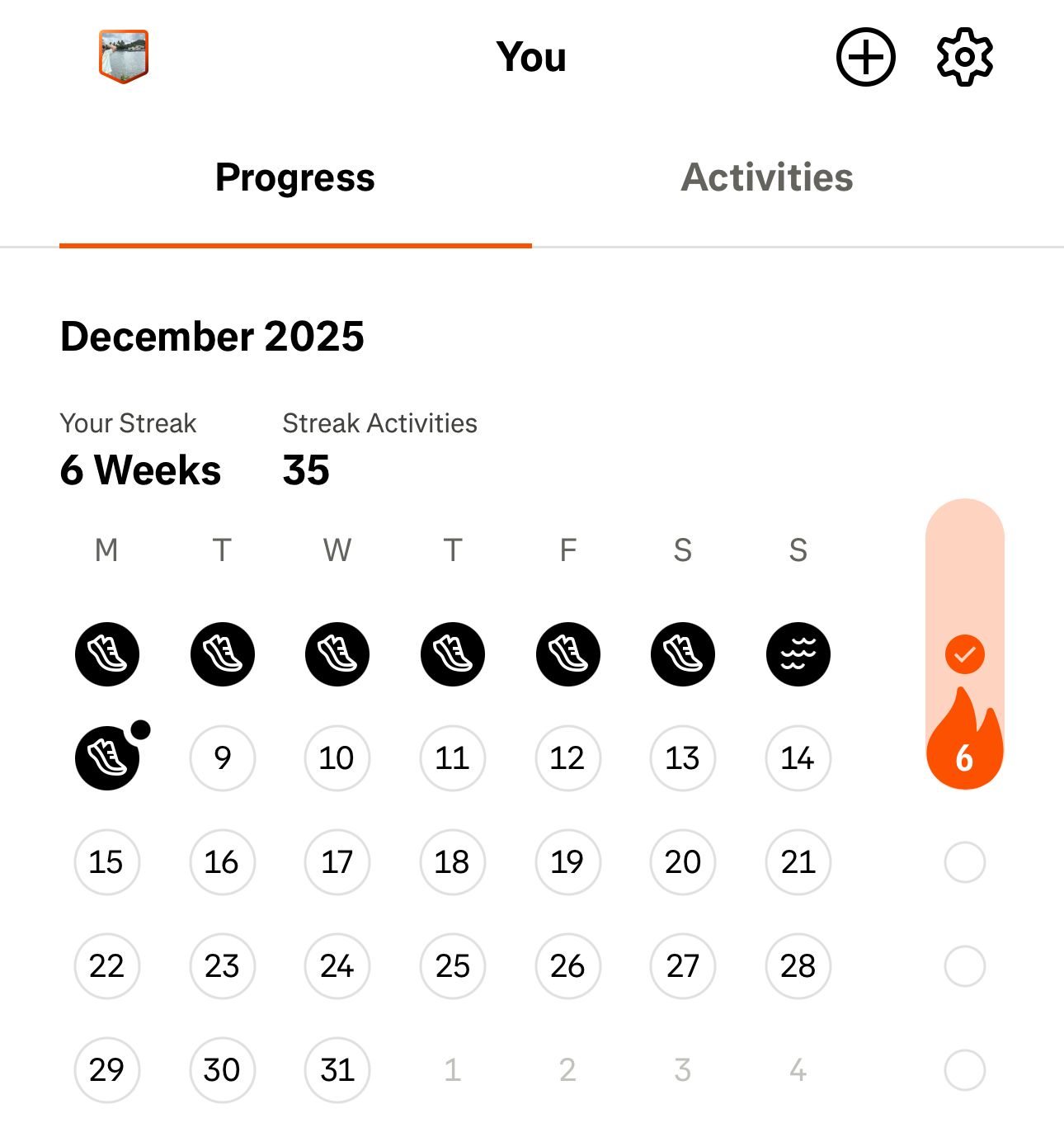
On day 5, missing a run costs you 5 days. On day 20, it costs you 20 days. The cost of quitting increases linearly with time, while the cost of continuing stays constant—just one more run.
I didn’t understand how powerful this was until around day 19. I was exhausted that day. Every part of me wanted to skip the run.
But looking at that “19” on Strava made skipping feel expensive. Like throwing away 19 days of collected data because the last experiment failed.
It’s not that I was motivated to run. I was motivated not to lose 19 days of work.
This is loss aversion. Behavioural economics. You’re more motivated to avoid losing something you have than to gain something new. I knew this from books. But I hadn’t used it on myself until now.
The streak didn’t give me energy. It just made the cost of quitting visible. And once the cost was visible, the choice became easier.
What This Actually Means
I think what I learnt here applies beyond running. It applies to building products, to research, to anything you want to do consistently.
The problem with most advice about habits is that it assumes motivation is the bottleneck. “You just need to want it more.” “Stay disciplined.” “Find your why.”
But motivation is finite. It depletes throughout the day like a battery. By 9PM after a full day of work, I have no motivation left. So any system that depends on motivation will fail by default.
What works instead is behavioural architecture. Design the system so the default behaviour is what you want. Remove the decision points. Make the exit harder than the entrance.
I didn’t run every day because I was motivated. I ran every day because I’d made not running harder than running. The rule was simple: run or don’t sleep. Given those options, running was easier.
But here’s something I’ve noticed: we already do this with things we don’t think about. You don’t decide whether to brush your teeth each night. You don’t weigh the pros and cons of locking your door. You just do them. The decision was made once, and now it’s automatic.
The question isn’t whether you can make something non-negotiable. You already do it all the time. The question is which things you choose to make non-negotiable.
The Thing I Didn’t Expect
Here’s something weird that happened around third week: I stopped caring about the streak.
For the first days, the streak was everything. It’s what kept me going on hard days. But around third week, something shifted. I wasn’t running to maintain the streak anymore. I was running because not running felt wrong.
Like when you’ve been swimming long enough that you don’t think about your breathing pattern anymore. It just happens. The behaviour had stabilised.
This is what habit formation actually looks like, I think. Not discipline getting stronger. Not motivation increasing. Just the default behaviour changing. What used to require a decision now happens automatically.
And once something is automatic, it doesn’t cost energy anymore. It just happens.
What I’d Do Differently
If I were starting this again, I’d make one change: I’d care less about the distance and more about the rule.
There were two days where I only ran 2.5km because I was exhausted from bad sleep. I counted those as failures. But they weren’t. The rule was ‘run before sleep,’ not ‘run 10km before sleep.’
The rule should have been: run some distance every day. Not: run 10km every day.
On those exhausted days, the pressure to hit 10km made everything harder. If the rule had just been ‘run,’ 1km would have counted as success.
This matters. Because on those exhausted days, the pressure to hit 10km made the whole thing feel harder than it needed to be. If the rule had just been “run”, I could have run 1km and still succeeded.
The point isn’t the distance. It’s whether the system holds under stress.
The Actual Insight
What did I learn after six attempts?
Consistency isn’t about motivation or discipline. It’s about behavioural architecture.
You can’t reliably make good decisions when you’re tired. You can’t depend on motivation at 11PM when you’re exhausted. What you can do is design a system where the good decision is the only decision.
Remove the choice. Make the rule simple. Make breaking the rule harder than following it. Then just follow the rule.
That’s not discipline. It’s physics. You’re not fighting against yourself anymore. You’re just taking the path of least resistance. You’ve just designed that path to go where you want.
Once you realise you can architect behaviour instead of motivating it, the question becomes: what else works this way?
Writing? Don’t sleep until you’ve written 100 words.
Research? Don’t start experiments until you’ve written the experimental setup.
Any behaviour you want to be consistent at: remove the alternative. Make the exit harder than the entrance.
The architecture is the point. The specific behaviour is just the implementation.