What Underprepared Execution Reveals
The only way to see what you actually have is to remove the plan.
Prepared performance is a kind of lie. Not intentionally. But it hides the difference between your plan and your actual capacity.
When you’ve prepared well, most of your execution becomes automatic. You stop thinking and start executing. And what looks like mastery is also a filter: you lose visibility into what’s actually there.
When a skill becomes automatic, it moves out of conscious processing. You run on stored patterns instead of real-time judgment. This is efficient. It’s what lets experienced people operate at speed. But it has a cost that rarely gets named: you can no longer distinguish what you genuinely have from what the preparation is handling for you.
The plan and your actual capacity look identical from the inside.
The only way to see the difference is to remove the scaffolding.
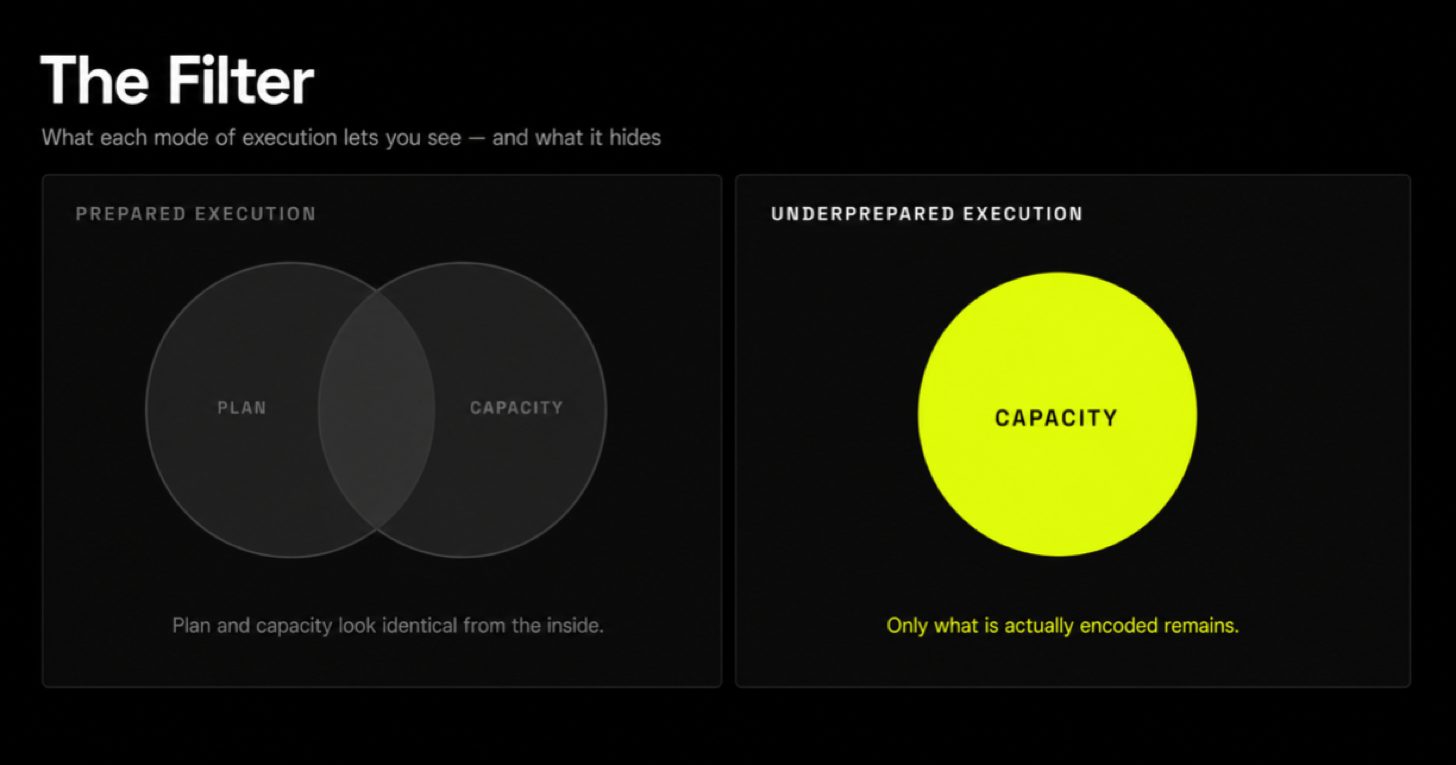
That’s what underprepared execution does. Without the plan, you have to think in real time, under load, with no fallback. And what’s left when the automatic version isn’t available is what you actually have. Not what you trained for. Not what you planned. What’s encoded.
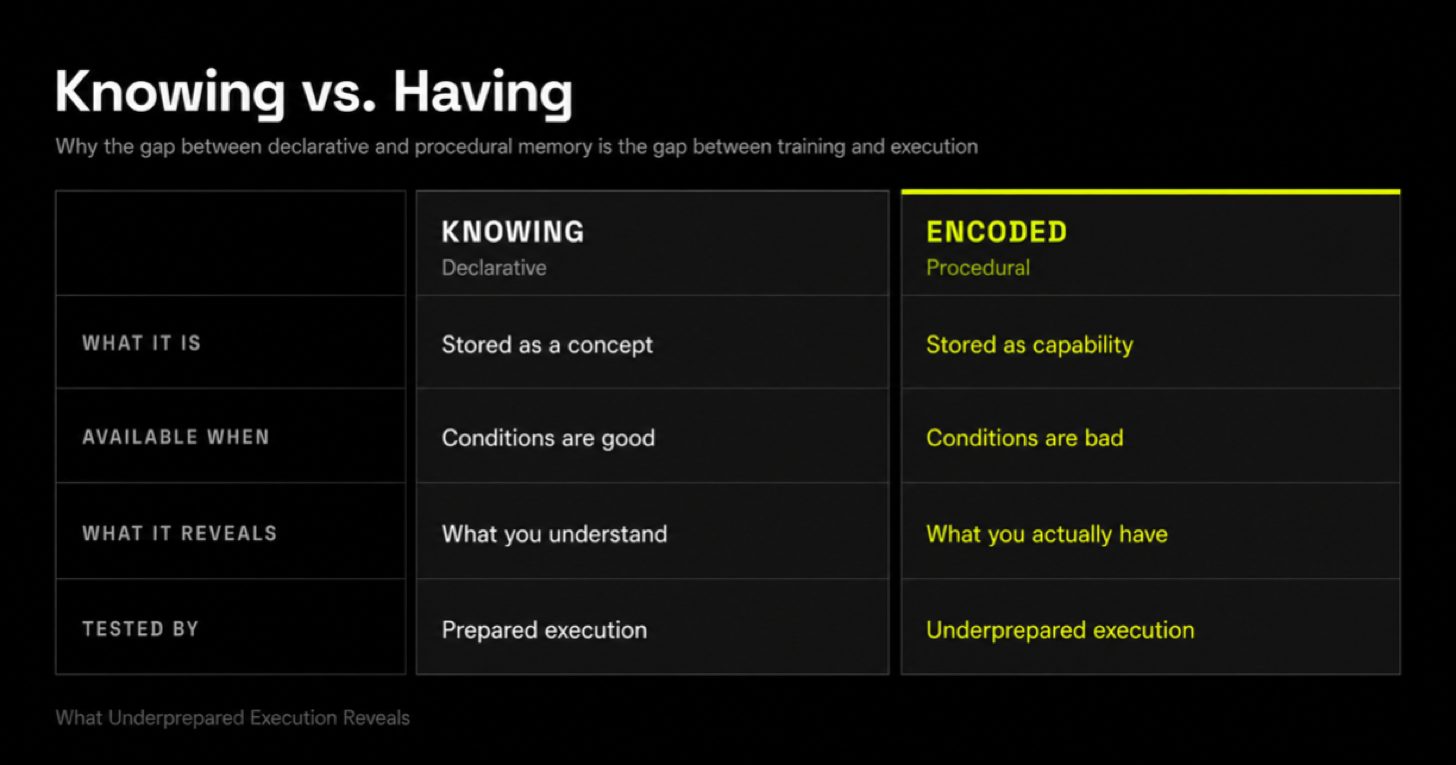
That last word matters. Cognitive science distinguishes between knowing something and having it encoded. You can know how to pace under pressure. You can know how to manage discomfort. But knowing is declarative: it’s stored as a concept. Encoded is procedural: it’s available when conditions are bad and nothing is helping.
Underprepared execution doesn’t test what you know. It tests what’s encoded.
Most people discover there’s a gap. That gap is the most honest data point you’ll ever get about your actual capacity. Not the number on the clock, not the metrics on the dashboard. What you could do when there was nothing there to help you.
When you finish something prepared, part of you credits the preparation. Reasonable. When you finish something underprepared, there’s nothing else to credit. The capacity is the only explanation left. That produces a different kind of self-knowledge, harder to dismiss and harder to explain away.
The obvious objection: isn’t it better to prepare? Yes. But that’s not the point. Prepared and underprepared execution give you different information. One of those kinds is nearly impossible to get any other way.
This is why it matters beyond sport. Shipping before the product is ready. Submitting before you’re confident. Pitching before the deck is finished. Anyone building something serious will find themselves underprepared repeatedly, not occasionally. The question isn’t whether it happens. It’s whether you understand what it’s showing you when it does.
Prepared execution tells you what’s possible when everything is in place.
Underprepared execution tells you what’s actually there, unfiltered, unassisted, yours.
You don’t need to seek out underprepared situations. You just need to stop treating them as failures when they happen.
One limit worth naming. When the underprepared gap is large enough that the downside becomes irreversible, the calculation changes. Injury that ends a training block. Shipping something that destroys trust. The only question worth asking: can the worst outcome be undone? If yes, proceed. If no, stop.
Underprepared is not reckless. It’s the one condition that tests what’s encoded. And that’s the data point that actually compounds.