Why You Can't Focus (It's Not a Discipline Problem)
System 2: Why your brain was built to wander and the design that works with it
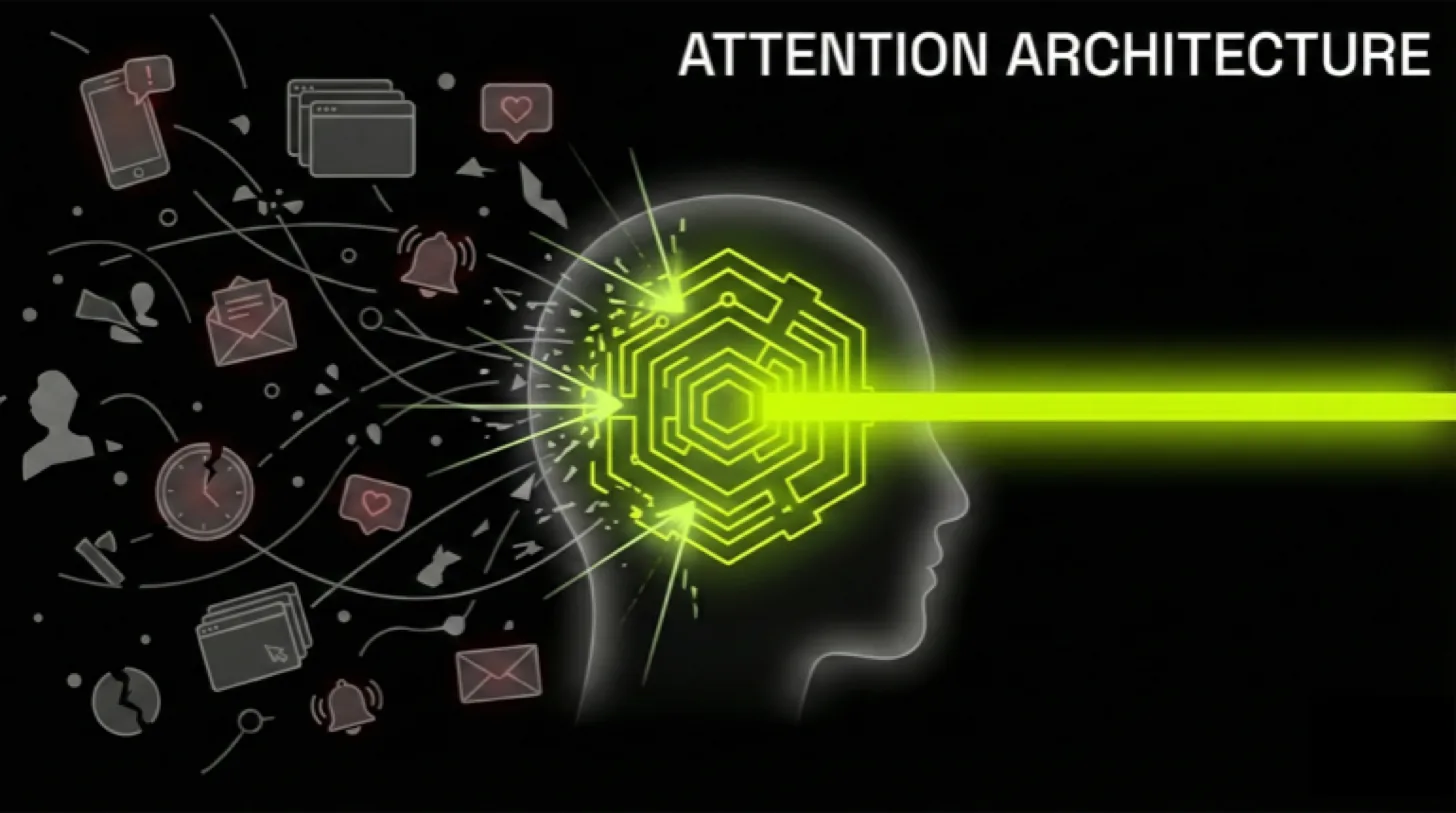
If you’re anything like me, you believe that focus is about willpower.
That the reason you can’t sit with your work for more than 20 minutes is because you lack discipline. That if you just tried harder, pushed through, gritted your teeth — you’d finally be able to do the deep work you know you’re capable of.
I believed that for years. And the harder I tried, the worse it got.
I’ve read every major book on focus. Used every app. Tried every technique. And I still found myself — more times than I’d like to admit — staring at a document I opened an hour ago, having typed nothing, wondering where the time went. Not because I didn’t care. I cared deeply.
I just could not stay with it.
Then I stopped blaming myself and looked at the research. I was not undisciplined. I was fighting my own biology and biology does not lose that fight.
The problem was never discipline. The problem was design
So whether you’re a builder who can’t get deep into the work, a student who reads the same paragraph four times without absorbing it, or someone who genuinely cares about their output but watches their attention leak away every single day, I want to walk you through the system that changed how I work.
This is not a list of tips. This is not another “turn off your phone” article.
This is the neuroscience of why your brain fights focus, the three invisible forces making it worse, and a complete architecture you can build in a single week that will protect your attention for far longer than that.
It will be comprehensive. Bookmark it. Take notes. Set aside 20 minutes to read it without checking anything else.
Let’s begin.
I — The attention crisis is worse than you think
You have read the same paragraph four times.
The document has been open for an hour. Forty minutes since you last typed anything. Somewhere in that gap, you checked Slack, opened a tab you cannot remember opening, and thought about dinner even though you just had lunch.
The task is not hard. You have done harder. You are not tired. You slept fine.
You just cannot stay with it.
And you are not alone. The data is staggering.
47 seconds. That is how long the average person now maintains focus on a screen before switching to something else. Half do not make it to 40. In 2004, people could hold focus for two and a half minutes. The environment changed. The brain did not.
Over 23 minutes. That is how long it takes to fully refocus after a single interruption, according to Gloria Mark’s research at UC Irvine. Not a quick reset. Over twenty minutes gone.
2,617. That is how many times the average person touches their phone each day. Heavy users hit 5,400.
The math does not work. The interruptions plus the recovery time plus the phone checks leave almost nothing for actual work.
Now project that forward.
If nothing changes, what does next Tuesday look like? You sit down at your desk. Open the document. Twenty minutes later, you have typed nothing. You check your phone. You open a tab you cannot remember opening. The familiar weight of wasting another morning settles in.
A year of that. Twelve months of half-finished projects, scattered days, and the quiet frustration of knowing you are capable of more than your output shows.
Five years of that. You have built a fraction of what you could have built. The gap between your potential and your output has become a permanent feature of your life. You stop calling it a bad phase. It is just how things are.
Ten years. You look back not at what you built, but at what you never started. Not because you lacked talent. Because you could never stay with it long enough to finish.
That is the real cost. And it compounds silently, every single day.
But it does not have to compound that way. Imagine the opposite. You sit down, and you stay. Ninety minutes pass. The work moves. You close the laptop knowing you did something real, not because you pushed harder, but because the system held.
That version is within reach. But only if you stop treating focus as a discipline problem and start treating it as a design problem.
System 01 (the-friction-model) solved the starting problem, the friction, the resistance, the mornings where you cannot seem to begin. But starting turns out to be the easier half. The harder half is staying. Staying with the task when the pull to check something feels like a physical itch. Staying when the brain offers a dozen reasons to switch. Staying when nothing is wrong except you cannot seem to stay.
That is an attention problem. And it has an architecture.
But to build that architecture, you first need to understand why your brain is working against you.
II — Your brain was never designed to focus
“My experience is what I agree to attend to. Only those items which I notice shape my mind.” — William James
Most productivity advice skips a crucial fact about the brain.
The brain’s default state is wandering, not focusing.
Focus is not natural. Wandering is natural.
Your brain has two major opposing networks. The first is a set of task-positive regions that activate when you focus on something external — working, reading, coding, writing. They require energy to maintain.
The second is the Default Mode Network, or DMN. This activates when you are not focused on anything external. Mind-wandering. Daydreaming. That random thought about dinner.
These networks tend to suppress each other. The moment you stop actively focusing, the DMN takes over. Think of holding a ball underwater. Release the pressure, and it floats back up. Focus requires constant downward pressure.
This reframe matters more than any technique I can give you.
Focus feels hard because it is hard. The brain is not broken. It is doing what brains do. And the solution is not to push harder against biology. The solution is to design systems that work with it.
Every person who tells you to “just focus harder” is telling you to hold the ball underwater with more force. What you actually need is a system that keeps the ball down for you.
That is what an architecture does. But before we build it, we need to identify the three forces that are actively sabotaging your attention every single day and the third one will change how you think about your phone forever.
III — The three invisible enemies stealing your attention
Three specific forces work against your focus. Understanding them changes how you approach the problem entirely.
Enemy one: attention residue
This concept comes from researcher Sophie Leroy. When you switch from Task A to Task B, part of your attention stays stuck on Task A. It does not fully transfer. There is residue.
Leroy ran experiments where she interrupted people in the middle of word puzzles and had them switch to evaluating resumes. The interrupted people performed significantly worse on the resume task. The stronger the residue, the worse the performance.
Here is how this plays out in real life. You are writing a report. You check email. You see a message that needs a response, but you do not respond yet. You go back to the report.
Now you are thinking about both. The email sits in the back of your mind. The report does not have your full attention. Neither task gets what it needs.
Every switch has a cost. The cost is invisible, but it is real.
Enemy two: task-switching cost
Research by Rubinstein, Meyer, and Evans measured this cost directly.
The brain cannot truly multitask on complex work. What we call multitasking is rapid task-switching. And each switch has a measurable cost. Some estimates put the total loss as high as 40 percent of productive time.
An 8-hour day with constant switching could mean losing hours to switching costs alone.
When you switch tasks, the brain does two things. First, goal shifting — the conscious decision to switch. Second, rule activation — deactivating the rules for Task A and activating the rules for Task B. Loading a completely new context.
Consider writing code while responding to Slack messages. Each Slack response requires stopping the coding thought, loading the conversation context, formulating a response, then returning to code, reloading where you were, and rebuilding the mental model. A 2-hour task becomes a 4-hour fragmented mess.
A recent simulation modeled this precisely. On a typical bad day, just two interruptions per hour with 20-minute recovery times; an 8-hour workday yields only one block of deep work lasting longer than an hour. One. But here is the striking part: reducing interruptions by just one per hour increased the likelihood of achieving deep work from 14 percent to 70 percent. The math confirms what the neuroscience predicts. Deep work is mathematically rare unless you deliberately design for it.
The prefrontal cortex has a bottleneck. It can only process one executive task at a time.
Multitasking on cognitively demanding work is a myth. It is rapid switching with compounding costs.
Enemy three: environmental triggers
In 2017, researchers at the University of Texas ran a study called Brain Drain. They tested around 800 smartphone users. The results sparked a wave of follow-up research.
The core finding: the mere presence of a smartphone appears to reduce available cognitive capacity. Even when the phone is face down. Even when it is turned off.
They had people do cognitive tests in three conditions. Phone on the desk. Phone in their pocket. Phone in another room.
Phone on desk: lowest performance. Phone in pocket: medium. Phone in another room: highest.
Your phone is a cue. The brain knows it is there. Part of your attention is constantly being used to not check it. That inhibition consumes cognitive resources.
Putting the phone on silent, face down, does not solve the problem. The brain still knows it is there.
I took this further than most people would. Every notification on my phone is off. All of them — except Slack and WhatsApp for genuinely urgent matters. I do not see anything until I choose to check. And during deep work, the phone is not on silent. It is off. Completely off. The first week felt strange, almost uncomfortable. That discomfort told me everything I needed to know about how much attention I was spending on a device I was not even using.
The solution is physical separation. Out of sight, out of mind. This is not just a saying. It is neurologically accurate.
Now, if these enemies seem overwhelming, that is because they are. You cannot defeat them with willpower. You need to understand the engine they are attacking because once you see how it works, the architecture we build later will make immediate sense.
IV — The focus engine is expensive, and it is running out of fuel
At the center of attention sits the prefrontal cortex. The CEO of the brain.
The PFC handles working memory, inhibition, cognitive flexibility, planning, and decision-making. It runs focus.
But the PFC is expensive.
It consumes significant glucose and oxygen relative to its size. And it fatigues with sustained use. Prolonged decision-making wears it down. Constant distraction resistance wears it down. Hour after hour of effortful thought wears it down.
This is why focus feels hardest at the end of the day. The PFC has been running all day without rest. And when the PFC underperforms, the Default Mode Network takes over.
The implication is profound and simple: there is a practical limit to how much deep focus you can sustain each day. The PFC needs protection, not just motivation.
Here is the part most people do not know.
The brain does not have constant energy throughout the day. It operates in waves.
The idea traces back to Nathaniel Kleitman, the father of modern sleep science. In 1963, he identified what he called the Basic Rest-Activity Cycle, or BRAC. The 90-minute cycles that govern your sleep stages — REM, non-REM, back to REM — Kleitman proposed that similar rhythms continue during waking hours.
Whether the exact mechanism is ultradian or not, the practical pattern holds: most people can sustain intense focus for roughly 60 to 90 minutes before performance starts to drop. Then the brain needs a period of recovery — 15 to 20 minutes — before the next wave. The research debate is about why. The lived experience is consistent.
Many high performers have converged on this pattern independently. Forcing focus well beyond 90 minutes yields rapidly diminishing returns. The brain fights back. Working with a rhythm, rather than against it, changes the equation entirely.
Before we move on, take a moment and honestly assess where you are right now.
- Level 1: Scattered. You rarely sustain focus for more than 15 minutes. The phone is always within reach. Deep work happens by accident, not by design.
- Level 2: Fragile. You can manage 25-30 minute blocks on a good day, but one interruption collapses the session. Recovery takes longer than the focus did.
- Level 3: Building. You can sustain 45-60 minutes of focused work with occasional drift. You have some environmental controls, but they are inconsistent.
- Level 4: Architectural. You consistently complete 90-minute deep blocks. Your environment, rhythm, and rituals are designed to protect your attention. Bad days still happen, but the system holds.
Most people nowadays are at Level 1 or 2. That is not a judgment. It is a starting point. The architecture we are about to build is designed to move you up — one level at a time.
You now understand the biology. The default is wandering. Three enemies are draining your attention. The focus engine is expensive and operates in waves. Now we can build the architecture that works with all of this instead of against it.
V — The attention architecture: 6 principles for building focus that lasts
These are not rules to follow rigidly. They are design parameters. Adjust them based on what works. But the principles themselves are grounded in the neuroscience we just covered, and they have transformed how I work.
Principle one: protect the environment
If something can distract you, it probably will. The goal is to remove cues before they trigger responses.
Phone exile. Not on the desk. Not face down. Not in a pocket. Another room entirely. The Brain Drain study showed this is what actually works.
Single-tab policy. One browser tab for the task. Close everything else. Every open tab is attention residue waiting to happen.
Notification batching. Turn off non-essential notifications. Schedule specific times to check messages. Two to three times per day is often enough.
Visual cleanliness. Clear desk, clearer mind. Only task-relevant items visible. Clutter is cognitive load.
The principle: design the environment so the default is focus, not distraction.
Principle two: respect the rhythm
Work with biology rather than against it.
Structure work in 90-minute focus blocks. Set a timer. Single task for the entire block. No switching. No checking. When the urge arises, notice it and return to the task. The urge passes.
Between blocks, take 20-minute recovery periods. Step away from the screen. Move. Let the Default Mode Network run. It needs time too. Phone scrolling during recovery is not rest. It is stimulation. The brain needs actual downtime.
Three to four deep blocks per day is the realistic maximum. Scheduling 8 hours of deep work leads to failure and guilt. Four blocks of 90 minutes equals 6 hours of true focus. That is exceptional output. Most people do not get 2 hours of real deep work in a day.
The hardest tasks belong in the first one or two blocks. That is when the PFC is freshest.
Principle three: single-point focus
One task. One outcome. One focus point.
Before every focus block, define the ONE thing. Not a to-do list. One item. Write it down and put it in front of you. “In this block, I will complete X.”
The parking lot method helps with intrusive thoughts. Keep a notepad nearby. When random thoughts intrude, write them down immediately. Do not engage. Just park them for later. The brain cannot hold open loops and focus at the same time. Writing closes the loop temporarily. It frees working memory.
When the urge to switch arises, one question: “What am I doing?” If drifted, return to the ONE thing. No judgment. Just redirect.
Single-point focus is not rigidity. It is intentionality. Choosing what gets your attention rather than letting impulses decide.
Principle four: focus rituals
Rituals reduce the decision cost of focusing.
Every time you have to decide to focus, willpower gets spent. Rituals automate the decision. They create a conditioned response.
A start ritual might look like: close all tabs, put phone away, fill water, write the ONE thing, start timer, begin. Same sequence every time. After enough repetitions, the ritual itself triggers focus mode. The brain learns: this sequence means it is time to focus.
A transition ritual signals the end of a focus block. Stand. Stretch. Walk to the window. A few deep breaths. Return. This tells the brain the focus period is over. Recovery now.
An end ritual closes the workday. Review what got accomplished. Write tomorrow’s first task. Close the laptop. This prevents work from bleeding into rest time. It closes the attention residue.
I underestimated rituals for years. I thought they were superficial. I was wrong. Rituals are behavioral cues that trigger automatic responses. Build them once, benefit repeatedly. They are the cheapest architectural investment you will ever make.
Principle five: train the muscle
Focus is a skill. Skills can be trained.
Meditation is attention training in its purest form. Focus on the breath. The mind wanders. Notice the wandering. Return to the breath. That moment of noticing and returning is the exercise. The wandering is not failure. It is the rep. Every return strengthens the circuit. Even 10 minutes a day makes a measurable difference.
Progressive training builds capacity gradually. Starting with 90-minute blocks is like walking into a gym and attempting a 200-kilo deadlift on day one. Week one: try 25-minute blocks. Weeks two and three: extend to 45 minutes. Week four and beyond: work up to 90 minutes.
Single-tasking practice extends beyond work. Watch a movie without a phone nearby. Read a chapter without checking anything. Have a conversation without glancing at notifications. Every instance of single-tasking strengthens the circuit.
“All of humanity’s problems stem from man’s inability to sit quietly in a room alone.” —Blaise Pascal
Boredom tolerance might be the hardest training. When boredom arises, the instinct is to reach for stimulation. Sitting with the discomfort instead allows the brain to recalibrate. Boredom is the precursor to focus and creativity. Killing boredom with the phone means never reaching the other side.
High boredom tolerance correlates with high focus capacity. That is not a coincidence.
Principle six: manage the fuel
Focus runs on neurochemistry. Depleted fuel means depleted focus, regardless of willpower.
Sleep is non-negotiable. Sleep deprivation impairs prefrontal function significantly. One bad night measurably reduces cognitive performance. There is no hack around sleep. Seven to eight hours. Protect it.
Glucose stability matters. The brain runs on glucose. Blood sugar crashes mean focus crashes. Protein, fat, and complex carbs. Hydration too. Dehydration impairs cognition more than most people realize.
Strategic caffeine helps when used intentionally. Caffeine blocks adenosine, the molecule that creates tiredness. Some experts recommend waiting 90 to 120 minutes after waking before the first coffee, allowing natural cortisol to peak first. Cut off caffeine 8 to 10 hours before bed. Using caffeine to mask sleep deprivation is borrowing from tomorrow.
Movement increases BDNF, which supports brain function. Even a 5-minute walk improves subsequent focus. Movement clears metabolic waste from the brain. Moving between focus blocks serves recovery.
Willpower cannot override depleted neurochemistry. Manage the fuel first. Then deploy the tactics.
VI — The daily shape
Here is what this looks like in practice. A framework that builds on the Morning Protocol from System 01, extending it into a full-day architecture.
- Morning: Attack. Protect your first 90 minutes. No phone. No email. No Slack. This is when the PFC is freshest. Use it for the hardest, most friction-heavy task. Single-point focus. One thing. Complete it before the world starts demanding your attention.
- Afternoon: Flow. Shift to different types of work. Creative tasks — writing, brainstorming, planning. Admin and lower-friction work. Emails, calls, tasks that do not require deep focus. Physical training fits well here too.
- Evening: Reset. Prep tomorrow. Lay out what to work on. Reduce friction for your morning self. No screens one hour before bed. Let the brain wind down. Blue light and stimulation disrupt sleep architecture. Protect sleep. This is when neuroplasticity consolidation happens.
Attack. Flow. Reset.
That is the shape of a day designed around biology rather than against it.
A note on the inevitable objection: “What if something urgent comes up during a focus block?” Most things feel urgent but are not. Training yourself to recognize the difference is part of the architecture. A true emergency can interrupt. A Slack message that could wait 90 minutes should. For roles that genuinely require immediate availability, shorter blocks work — 45 minutes instead of 90. The goal is not perfection. The goal is protecting more attention than before.
Implementation resources
This essay provides the model. These tools help apply it.
- Focus Environment Audit (Download): Eliminate environmental triggers that drain cognitive capacity (10-15 min)
- 90/20 Focus Block Planner (Download): Structure days around ultradian rhythms for maximum deep work (5 min daily)
- Attention Training Log (Download): Build focus capacity from 25 to 90 minutes through progressive training (4-week program)
Get the complete toolkit here
VII — Turn your focus into a fortress
The common assumption about focus is that it is about trying harder. Push through. Be disciplined. Grind.
The evidence points elsewhere.
Focus is less about willpower and more about design. Environment design. Rhythm design. Ritual design. Fuel management. You do not need to become a different person. You need to build a different system.
Think of everything we covered as a set of concentric walls, like a fortress protecting the most valuable thing you own: your attention.
The outer wall is your environment. Phone exiled. Tabs closed. Notifications dead. Nothing gets through unless you let it.
The second wall is your rhythm. 90-minute blocks. 20-minute recoveries. The wave, not the grind. Biology working for you instead of against you.
The third wall is your focus point. One task. One outcome. The parking lot catches everything else. Nothing intrudes.
The inner wall is your rituals. Start. Transition. End. Each one a gate that opens and closes deliberately.
At the center is the fuel. Sleep. Glucose. Movement. Caffeine, used with intention. The neurochemistry that makes all of it possible.
Nothing gets through all five walls. And the more you practice, the stronger each wall becomes. Bad days still happen. But architecture holds more consistently than willpower ever will.
This is not something you do once. This is something you build. And once built, it becomes how you operate.
You stop being someone who struggles with focus. You become someone who protects their attention by design. That is not a small shift. That is a different person.
You do not go back to the fragmented mess, because you cannot unsee what focus actually feels like.
But even the strongest fortress runs on fuel. Without managing energy, burnout follows. That is System 03 — The Energy Equation. Where the sustainability problem gets solved.
— Imad